Human Resource Development
- PolicyJump to the applicable section
- Grading System and Specialized FieldsJump to the applicable section
- Evaluation and Remuneration SystemsJump to the applicable section
- Career Development Support SystemsJump to the applicable section
- KDDI DX UniversityJump to the applicable section
- Other Human Resource Development Programs and InitiativesJump to the applicable section
Policy
KDDI has identified "Human Resources First" as a material issue, and in line with this policy, we secure and develop talent to enhance employee capabilities.
Against this backdrop, we introduced the KDDI Version Job Style Personnel System in 2020 based on the concept of creating and nurturing professionals.
By introducing the system, we aim not only to attract talent with high levels of expertise, but also to create a culture where individuals can take on challenges aligned with their capabilities and life stages, thereby generating a virtuous cycle of growth through those challenges.
There are two major features that characterize the KDDI Version.
First, we defined 30 specialized fields and clarified roles and skills, thereby creating an environment where employees can deepen their expertise.
Next, we place importance on co-creation and collaboration, ensuring that human skills that lead the organization to success are properly valued. In line with evaluations, we have a compensation system that rewards employees directly.
Furthermore, to support the improvement of employees' expertise and human skills, we offer career development support programs, including our in-house educational institution, KDDI DX University.
Grading System and Specialized Fields
KDDI has established "grades" categorized based on the differences in the size of job roles and the expected human resource requirements. Among these, managerial positions (referred to as personnel in managerial positions) are divided into leadership and professional tracks. The roles and human resource requirements expected at each grade are defined in the grade definition document, and these serve as benchmarks for career development, target setting, performance evaluation, and grade appointments, among other system criteria.
In the KDDI Version Job Style Personnel System, we position "specialized fields" as units of expertise for each KDDI employee to excel as professionals. For each specialized field, we have defined a specialized field document that further specifies the grade definitions. Alongside the actual job descriptions, employees can understand the roles, abilities, and degree of specialization required individually.
- *The 30 specialized fields are as follows:
Consumer Sales; Corporate Sales; Sales Support; Business Strategy and Business Management; Marketing; Audit (Risk Management); Mergers & Acquisitions and Investment; External Affairs; General Affairs; Human Resources; Legal and Intellectual Property; Accounting & Finance; Procurement and Logistics; Customer Service; RAN, Core, and Fixed Network Engineer; Satellite, Shortwave, and Submarine Cable; Construction-related Network Engineer; Product Development Engineer; Solutions SE; Facility Engineer; Information Security; Negotiator; Network Architect; Analyst; Research and Development; Business Development; Consultant & Product Manager; Technologist; Experience Architect; and Data Science & Management.
Evaluation and Remuneration Systems
To ensure fair and transparent personnel evaluations, KDDI has eliminated evaluations based on job grades and seniority and places emphasis on evaluations based on performance and challenges as well as competencies.
Performance focuses not only on the performance itself but also on the challenging efforts to achieve it, while competencies focus on human skills and expertise. To help each employee maximize their performance and develop their competencies, we hold regular (monthly) one-on-one sessions with their supervisors to build trust and support their career development.
When evaluating performance and challenges, we set performance targets and the challenging efforts to achieve them at the start of the period, make course corrections through one-on-one sessions during the period, and conduct a review and evaluation at the end of the period.
When evaluating competencies, human skills and expertise are assessed through 360-degree evaluations and supervisor evaluations.
Based on these evaluation results, we visualize each employee's position and reflect this in their career development and remuneration.
The bonus consists of two components: the company's operating performance bonus and an individual performance-linked bonus. It is determined based on the company's operating performance and individual performance.
Career Development Support Systems
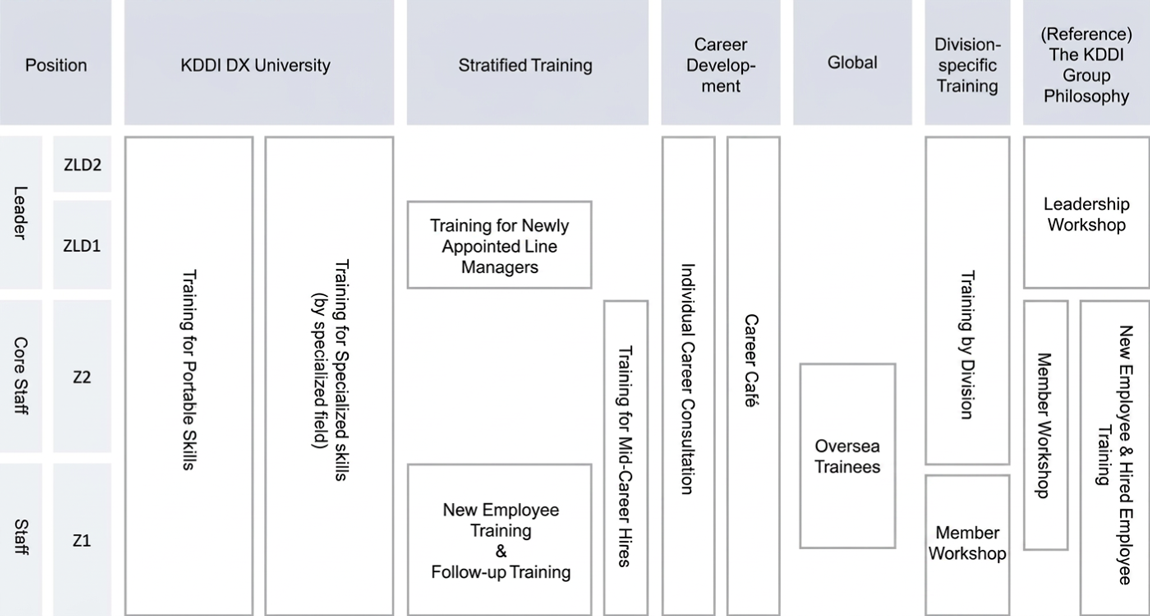
We have established training programs and career support tailored to each position, helping employees enhance their skills and grow.
Through KDDI DX University, we provide educational opportunities that are available to all employees, and we also offer level-based support such as training for newly appointed line managers and career consultations.
We also address individual career needs through selective training programs and division-specific training.
KDDI DX University
"KDDI DX University offers programs year-round that develop professional talent responsible for KDDI's business and provide the skills necessary for employees to realize their careers.
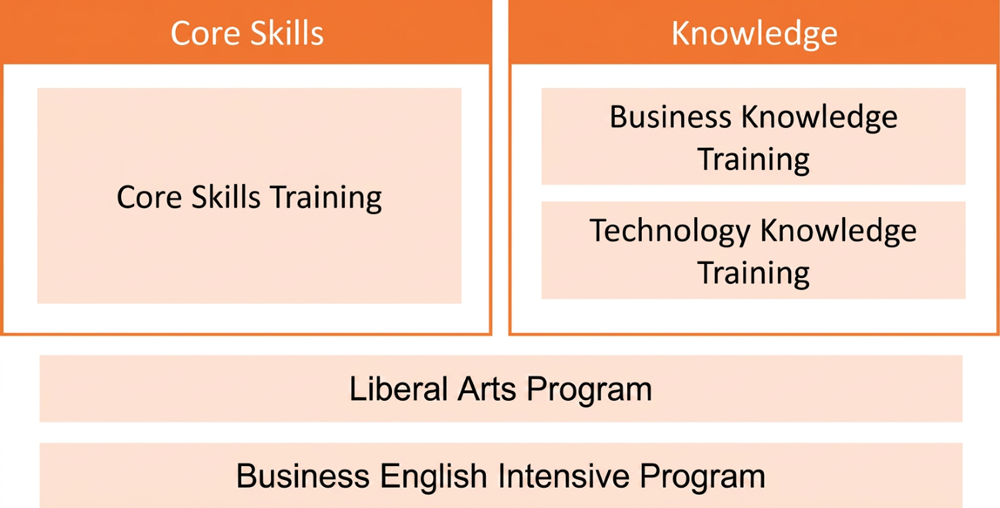
There are approximately 120 specialized skills, defined for each of the 30 specialized fields, as well as portable skills that include 18 core skills and knowledge in three categories defined by KDDI and the fundamentals of DX and AI. We support employees' skill enhancement through diverse training styles―online, in-person, and e-learning (Note 1).
Employees can participate in the necessary programs according to their own skills and career plans.
- (Note 1)E-learning is also available to outgoing and incoming secondees, and contract (fixed-term) employees."
 |
Program Features | |
|---|---|---|
|
 |
Practical programs developed by experts and external partners in each specialized field, designed for easy application in actual work |
|
 |
Diverse programs that build a robust foundation amid wide-ranging business fields and career opportunities, enabling employees to demonstrate their capabilities even when changing specialized fields or departments |
Examples of Training for Portable Skills
Leadership and organizational management (training for core skills)
This e-learning program aims to help leaders learn the behaviors necessary to enhance their organization's performance and enable immediate application in the workplace.
Business Process Design Program (Knowledge Training)
This training program enables participants to develop practical skills in business process improvement by using their own work as a case study. Participants learn how to visualize business processes, identify issues, and formulate improvement measures and implementation plans. Through a combination of e-learning and in-person workshops, as well as individualized feedback from instructors, participants acquire business improvement skills that can be immediately applied in the workplace.
Examples of Training by Specialized Field
Training in DX fields
| Content |
|
|---|---|
| Objectives and business benefits | Enhancing the pool of DX talent in fields such as Business Development and Data Scientist, who possess the capability to design businesses based on data for internal and external transformation and to drive new business development and internal reforms by engaging diverse stakeholders. |
| Quantitative business benefits | In fiscal 2025, a total of 970 employees participated in the program, 216 of whom grew into professional talent in DX fields as defined by KDDI, supporting growth in these highest-priority areas. |
| Percentage of FTEs participating in the program | 10.2% |
KMU (KDDI Marketing University) (one of the training programs in sales and marketing fields)
| Content |
|
|---|---|
| Objectives and business benefits |
|
| Quantitative business benefits |
|
| Percentage of FTEs participating in the program | 7.5% |
- (Note 2)Details of KMU
- 1.Stance training
At the start of the program, in a creative setting, participants learn the path to career autonomy from professional marketers and set their aspirations and goals. - 2.Fundamental skills training
Aiming to acquire practical skills such as presentation, design thinking, and project management, participants devote nearly half of the class time to exercises and activities for hands-on learning. - 3.Marketing common skills training
Participants learn the following three common skills essential for professional marketers through a three-step program: a thoroughly customer-centric perspective, market adaptability, and collaboration skills. - 4.Marketing specialized skills training
Participants are divided into each job role to acquire knowledge and practical experience in parallel, cultivating the foundation to become a professional marketer in each field. - 5.Skill assessment
To understand the growth of KMU participants and the transformation status of the entire organization into a group of professional talent, we develop a skill dictionary (skill definition document) and conduct regular skill assessments in accordance with the proficiency standards defined therein.
- 1.Stance training
- (Note 3)Reference values: Non-participant scores (excluding line managers) increased by 3 points; the company-wide average increased by 1 point.
- (Note 4)Cost reduction figures are restricted to internal stakeholders and are not disclosed externally.
Other Human Resource Development Programs and Initiatives
Key Personnel Systems and Measures
In addition to the Job Style Personnel System and Career Development Support System, we provide employees with regular opportunities to reflect on their careers. Through measures such as monthly one-on-one sessions with their supervisors and consultations with career consultants, employees are encouraged to set their direction and engage in concrete career development efforts, such as internal side jobs or transfers.
| System / Program | Overview |
|---|---|
| Career plan declaration | Once a year, employees reflect on their experiences and sources of motivation, identify their strengths and values, and clarify their future career aspirations along with the experiences needed to achieve them. |
| Individual career consultation | Employees can receive one-on-one career consultations with qualified in-house career consultants to discuss and address a wide range of career-related concerns and challenges. |
| Group side job program (internal side job program) | Alongside the job rotation and internal job posting systems, this program aims to support autonomous career development by providing employees with opportunities to engage in practical assignments different from their primary roles for up to 20% of their working hours. |
| Internal job posting system | This system leverages the KDDI Group's broad business domains to support employees in realizing their careers by providing opportunities to proactively take on new positions of their own volition. |
| Internal free agent (FA) program | This program aims to promote organizational and business growth by transferring top performers to growth areas and critical positions, and to provide opportunities to pursue the realization of their careers. |
| Executive Assistant System | Prospective next-generation leaders assume positions in which they perform duties assisting executives such as directors, learning the mindset of management firsthand. |
| Overseas trainee | This system aims to develop universal talent, allowing participants to gain up to two years of practical experience in areas such as sales, engineering, or corporate operations at sites outside Japan (such as KDDI overseas subsidiaries). |
Department-Specific Development Measures
Regarding development programs for candidates for managerial positions, each division plans and implements these programs to address its own challenges.
Community Activities
At KDDI, employees themselves take the lead in running community activities. These activities, conducted through teams and networks, aim to share skills and know-how for their duties, promoting the growth of the entire organization.
The main activities include information sharing via online chat tools and study sessions or seminars where employees themselves serve as instructors. This enables employees to continually learn the latest knowledge and technologies from one another.
- KDDI employee selected for the Microsoft MVP in the M365 Copilot category (in Japanese only)Open in a new window
- Toward a professional UX design group! Design Community #YORISOI (in Japanese only)Open in a new window
- Enjoy, get hands-on, and level up your skills! Data Analysis and Automation Community (in Japanese only)Open in a new window