Environmental Management
- Internal Environmental AuditsJump to the applicable section
- Environmental Data Collection and Third-party AssuranceJump to the applicable section
- Compliance with Environmental Laws and RegulationsJump to the applicable section
- Promoting Waste ReductionJump to the applicable section
- Promotion of Plastic ReductionJump to the applicable section
- Approach to Water UseJump to the applicable section
- Education and Awareness Raising for EmployeesJump to the applicable section
- Acquiring the Eco ICT MarkJump to the applicable section
- Green Supported by ICTsJump to the applicable section
- Promoting Green ProcurementJump to the applicable section
- Introduction of Internal Carbon Pricing (ICP) SystemJump to the applicable section
- Implementation of Life Cycle Assessments (LCA)Jump to the applicable section
- Self-Assessment Checklist for CO2 Emission Reduction from Energy Conservation Efforts by Telecommunications Services ProviderJump to the applicable section
Internal Environmental Audits
We at KDDI Group conduct internal environmental audits as required by ISO 14001. Auditors are selected by the Sustainability Planning Department.
These audits target the offices of KDDI and its group companies, focusing on three areas: [1] Integration of company-wide challenges into environmental objectives [2] Compliance with environmental laws and regulations [3] Operation of the Environmental Management System (EMS) Self-checks using checklists and audits by auditors are conducted continuously. These initiatives provide opportunities to improve energy performance by monitoring, measuring, analyzing, and evaluating energy usage. Specifically, at telecommunications facilities, attention is given to the power consumption of rectifiers, and the utilization rate of each rectifier is checked. Units are reduced as appropriate, taking safety margins into account, to identify and implement opportunities for improving energy performance.
KDDI Group ISO 14001 Certification Acquisition(certified by Japan Quality Assurance Organization, JQA) (As of the end of March 2026)
KDDI Corporation, Okinawa Cellular Telephone Company, KDDI Research, Inc., KDDI Technology Corporation, KDDI Engineering Corporation, Japan Telecommunication Engineering Service Co., Ltd., Public Interest Incorporated Foundation KDDI Foundation, Chubu Telecommunications Company, Inc., KDDI Matomete Office Co., Ltd., and LAC Co., Ltd.
A total of 10 companies and organizations are certified.
Environmental Data Collection and Third-party Assurance
KDDI collects environmental data on energy, waste, water, and other topics as well as supervises and evaluates the trends in each data set within our framework of promoting environmental activities. To ensure the reliability of collected environmental data, we have obtained third-party assurances. When verifying this data, verification organizations provide us with opportunities to obtain advice on reducing burdens related to energy, waste, water, and so forth. For data for which we have obtained assurance, please see the following.
Compliance with Environmental Laws and Regulations
Compliance with Various Environmental Management Laws and Regulations
In order to prevent or reduce environmental impacts by our business activities, we strictly comply with national environmental laws and regulations, as well as with local ordinances and agreements. In KDDI, there were no violations of environmental laws and regulations in fiscal 2021.
There were no environmental contaminations, such as leakage or outflow of hazardous substances either.
Related Laws and Regulations
- Act on the Rational Use of Energy
- Act on the Promotion of Sorted Collection and Recycling of Containers and Packaging
- Waste Management and Public Cleansing Act
- Act on Rational Use and Proper Management of Fluorocarbons
- Law Concerning Special Measures for Promotion of Proper Treatment of PCB Wastes
- Tokyo Metropolitan Environmental Security Ordinance
Promoting Waste Reduction
We promote reuse activities that regenerate and effectively use retired telecommunications facilities. We also conduct material recycling that turns unneeded equipment and structural materials into resources. We will continue our commitment to reuse and recycle communication equipment, including base stations, retired due to regular upgrades.
Appropriate Processing of PCB-Containing Equipment
In accordance with the PCB Management Rules set out for the purpose of proper management of PCBs and prevention of accidents, KDDI is promoting the disposal of retired equipment that contains PCBs. The remaining equipment containing high concentrations of PCBs was completed by the end of March 2023. The disposal of equipment containing low concentrations of PCBs is expected to be completed by the end of FY2024.
Promotion of Plastic Reduction
As part of its efforts to conserve the global environment, KDDI and OKINAWA CELLULAR TELEPHONE COMPANY have adopted paper shopping bags with reduced plastic usage for approximately 4.2 million bags used annually at au Style shops, au Shops, and UQ Spot shops. For plastic shopping bags, materials containing 50% recycled content are used. By utilizing recycled materials derived from previously used plastic, the companies contribute to reducing the production of new plastic.
Approach to Water Use
There are fears of losing water resources because of increasing global population and decreasing water availability due to climate change. As disputes concerning water distribution and pollution have broken out in various locations around the world, it is significant to make efficient use of water. We are making efforts to reduce water use in our business activities as well as to offer products and services that contribute to efficient water use.
Education and Awareness Raising for Employees
We believe that enhancing the environmental awareness of all employees and encouraging them to better understand environmental issues are essential to promote our environmental activities.
| Initiative | Target | Details |
|---|---|---|
| Briefing session at the start of the term | KDDI Group personnel responsible for environmental ISO | Themes: KDDI's environmental management system (EMS), environmental laws and regulations, details of new regulation revisions, trends in environmental issues (reduction of energy consumption (energy conservation), waste reduction, water consumption reduction, etc.) |
| Training of internal environmental auditors | Trained through seminars and study sessions | |
| E-learning | All employees of KDDI Group *1 | Theme: "Understanding the Strengthening of Management Infrastructure - KDDI's Initiatives for Utilizing Renewable Energy to Achieve Carbon Neutrality" |
| Internal seminar | All employees | Theme: "The Need for a Circular Economy and KDDI's Initiatives" |
| Education | All employees | Internal newsletter theme: "Considering the Waste Problem: Business from Social Issues," "Products, sales methods, and purchasing behavior that consider waste reduction and environmental issues, etc." |
- *1Excludes key management positions.
Acquiring the Eco ICT Mark
KDDI has acquired the Eco ICT Mark established by the ICT Ecology Guideline Council *2 to work toward improving environmental consciousness and reducing environmental impacts.
- *2A council aiming for establishing energy conservation indices and other standards to be referenced when procuring ICT devices and data centers
Green Supported by ICTs
Reducing Power Consumption and Undertaking Disaster Measure Initiatives at Base Stations
The Environmental Eco Label is granted to KDDI ICT services that contribute to reducing the environmental impact of customers and society (reducing CO2 emissions).
| Environmental Eco Label services | Content |
|---|---|
| KDDI Cloud Platform Service | KDDI operates and maintains this platform, enabling customers to increase or decrease their server capacity remotely from their own offices, without having to travel to the data center where the servers are located. Furthermore, customers can reduce the amount of CO2 emissions they are responsible for by transferring the servers that they install, operate and maintain themselves (on-premises environment) to the KDDI Cloud Platform Service. With this service, server operations are performed with an economy of scale unique to a telecommunications operator, enabling an approximately 38% reduction in CO2 emissions per server per year in comparison to when customers operate their servers themselves. |
| Telehouse Data Center Services | These data centers have high power supply capacity, highly efficient and reliable power generation equipment, energy-efficient air conditioning equipment, LED lighting, outdoor lights that use wind and solar power and other advanced, energy-efficient equipment. |
| KDDI IoT Communication Service LPWA | This telecommunications service uses LPWA technology, which utilizes KDDI's 4G LTE network. This technology reduces the power consumed by telecommunication devices and provides telecommunications coverage over a wider area. |
| au Denki RE100 Menu and Non-Carbon Menu | Under the RE100 Menu, we supply electricity that meets RE100 criteria by supplying electricity derived from renewable energy sources (including electricity under Feed-in Tariff scheme) and offsetting carbon through the purchase of J-Credit (derived from renewable energy). Under the Non-Carbon Menu, we supply electricity with zero CO2 emissions derived from the electricity purchase by utilizing J-credit scheme. |
Promoting Green Procurement
We formulated the KDDI Green Procurement Guidelines to promote purchasing of more environmentally conscious products and business equipment (communication devices, air conditioning systems and power supply facilities) with high energy-saving performance. The Guidelines target the devices defined in the latest Ecology Guideline for the ICT Industry specified by the ICT Ecology Guideline Council.
We also apply the KDDI Group Sustainable and Responsible Procurement Guidelines to our business partners and follow up on their response toward environmental management, using the Responsible Procurement Surveys.
Response to Act on Promoting Green Procurement
KDDI has a lineup of products that meet the requirements of the Japanese government's Law on Promoting Green Purchasing.
All current mobile phones, smartphones, data devices, and their accessories comply with the requirements of the Green Purchasing Law.
Introduction of Internal Carbon Pricing (ICP) System
KDDI introduced an Internal Carbon Pricing (ICP) system on February 28, 2023, setting an internal price for carbon dioxide (CO2) emissions to serve as a criterion for investment decisions. Through the implementation of ICP, the company aims to promote awareness among employees and further accelerate energy-saving and renewable energy investments that contribute to achieving carbon neutrality.
■Internal carbon price:
JPY 14,000 per metric tonne of CO2e
■Approach:
KDDI applies both shadow price and implicit price approaches.
■The ICP is applied to various business decision-making processes, including:*3
-
- Installation of solar panels at mobile base stations and other renewable energy generation facilities
- Introduction of energy-saving technologies, such as improving air-conditioning efficiency
- Upgrading equipment to enhance energy efficiency
- Long-term procurement of renewable energy through Power Purchase Agreements (PPAs)
The scope of application will be gradually expanded going forward.
- *3At present, the ICP applies to Scope 1 (direct emissions) and Scope 2 (indirect emissions).
Implementation of Life Cycle Assessments (LCA)
We are working on LCAs that assess environmental impact by calculating CO2 emitted through all processes related to products and services, including manufacture, use, disposal and recycling.*4 Since fiscal 2008, we have regularly conducted LCAs for the "au" and "au Hikari" brands every three years. We conducted LCAs in fiscal 2021.
- *4The environmental impact from disposal and recycling are included in environmental impact from manufacture.
Environmental Impact of "au"
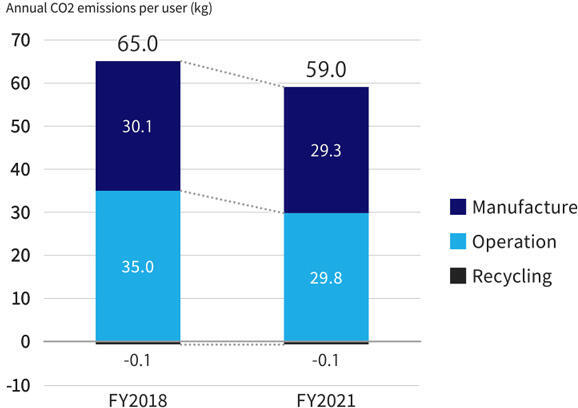
CO2 emissions per "au" user decreased 10.8% from the previous assessment. Despite an increase in smartphone battery capacity, overall CO2 emissions from cell phones have decreased as a result of lower smartphone manufacturing costs and increased purchasing demand for lower-cost products.
Environmental Impact of "au Hikari"
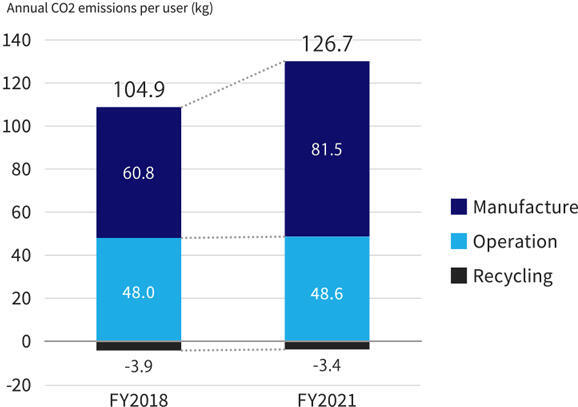
CO2 emissions per "au Hikari" user increased 20.8% from the previous assessment. On-premises equipment and network-side equipment were replaced with high-performance 10 Gigabit service-compatible equipment, and overall CO2 emissions increased in line with the increase in power consumption.
Self-Assessment Checklist for CO2 Emission Reduction from Energy Conservation Efforts by Telecommunications Services Provider
| Assessment items | Implementation, measures taken | ||
|---|---|---|---|
| Preparation of a voluntary ecological action plan | 1 | Has a voluntary ecological action plan stipulating various efforts directed at reducing CO2 emissions through energy conservation been created and is it being executed? | We have formulated and are implementing medium-term environmental conservation plans based on the KDDI Environmental Charter. |
| 2 | Does the ecological policy include specific efforts stipulating numerical targets for the reduction of CO2 emissions through energy conservation? | A medium- to long-term environmental conservation plan "KDDI GREEN PLAN" included the following targets. | |
| 3 | Is the ecological policy documented and disseminated inside and out-side of the company? Does the company carry out activities to inform and enlighten its employees? Is the company working to raise ecological awareness? |
|
|
| 4 | Does the company disclose to the general public its activities and data such as CO2 emission reduction? | The progress toward the achievement of the trend targets for the medium-term environmental conservation plan is disclosed in the Sustainability Report and on the corporate website. | |
| Efforts relating to procurement | 5 | In regard to ICT equipment and data center services, has the company prepared a procurement standard based on assessment standards specified in this Guideline? Is procurement carried out in accordance with the standard? | We conduct procurement activities in accordance with the KDDI Green Procurement Guidelines. Promoting Green Procurement (on this page) |
| 6 | Is the company cognizant of energy conservation in procuring office equipment, supplies and logistics (e.g., green purchasing)? | KDDI promotes green purchasing under the KDDI Group Sustainable and Responsible Procurement Guidelines. | |
| Promotion regime | 7 | In relation to efforts to reduce CO2 emissions through energy conservation, has the company assigned a person or department to be responsible for such matters? | The Sustainability Management Division was established. |
| 8 | Is there a regime in place using internal audits or other means to keep appropriate track of the implementation of measures and achievement of targets set forth in the voluntary ecological action plan? | We monitor the implementation and the achievement level, conduct inspections and improve through internal audits under the Environmental ISO Management System. | |
| Other ecological activities | 9 | Are ecologically friendly efforts being made other than activities to save energy? | We consider the promotion of 3Rs (Reduce, Reuse, Recycle) to also be a significant issue and are committed to the following initiatives:
|
| 10 | Is the company involved in ecological preservation activities in collaboration with local communities? | We implement environmental conservation activities across Japan, together with our employees and local stakeholders such as local authorities and NPOs. | |