Environmental Policy
- KDDI's Environmental Policy and Promotion Structure
- KDDI Environmental Charter
- The KDDI GREEN PLAN - A medium- and long-term environmental conservation plan
- Decarbonized society, Carbon neutral, net zero
- Circular Economy
- Biodiversity
- Obtained SBT Net-Zero Certification from the international climate change initiative
- KDDI's effort to conserve environment
- Engagement with Policymakers and Collaboration with External Organizations to Achieve Carbon Neutrality
KDDI's Environmental Policy and Promotion Structure
Our attitude toward environmental conservation is defined in the KDDI Environmental Charter with the approval of the President. Here, the Manifesto (Approach to Global Environmental Problems), which is the highest-level concept, and the Policy to direct our concrete initiatives have been established.
In addition, to raise ecological awareness, we promote employee understanding of the impact of our business activities on the environment through training and other internal awareness programs, and we seek to resolve environmental issues through communication with internal and external stakeholders.
KDDI will encourage KDDI's partners and suppliers *1 to endorse and cooperate in this charter, and will also cover all of our business activities.
This Charter will encourage not only the KDDI Group*1 but also KDDI's partners and suppliers*2 to endorse and cooperate with the Charter, and will cover all of our business activities.
- *1Includes distribution and logistics, subcontractors, etc.
- *2Distribution and logistics, outsourcing partners, etc.
KDDI Environmental Charter
KDDI Environmental Charter is composed of two tiers, the Manifesto (Approach to Global Environmental Problems) which is the highest concept, and the Action Guideline for defining the direction of concrete initiatives.
Manifesto
The KDDI Group recognizes the importance of fulfilling its duty as a responsible global corporate citizen to conserve and protect the Earth's irreplaceable environment that future generations will inherit. We are committed to programs featuring environmental enrichment activities that will benefit all of our descendants.
We believe the powerful driver to achieve this will be the innovations through collaborations and co-creations transcending the boarders of companies and organizations.
We do this by blending communication into every industry through the safe and secure communication platforms we provide, supporting business activities and customers in every scene solve problems. The aim is to reduce stress on the environment and play our part in bringing about a sustainable and robust society.
Furthermore, based on the state-of-the-art technologies we have developed-including communication technologies, our impact will extend to helping to solve diverse and complex societal and environmental problems and provide services capitalizing on customer touchpoints, The aim is for sustainable growth together with the environment and society, which are the foundations of our business.
We will promote growth-oriented sustainability management that creates a positive cycle for the environment, society, and economy. And through striving to bring about a decarbonized society, we will conserve biodiversity and work toward a circular economy so that the future generations can inherit the Earth's irreplaceable environment in good shape.
Policy
Promotion of Environmentally Friendly Businesses
We regularly monitor the environmental impacts of our business activities and strive to achieve continuous improvement. To this end, we establish and operate the required environmental management system. We also quantitatively assess the impacts of our supply chain on the global environment and promote initiatives to reduce environmental impacts. We have set targets for each of these measures and are carrying out activities. Specific measures are outlined below.
- 1.Achieving a decarbonized society
To protect ecosystems and society from the serious impacts of climate change, we contribute to reducing greenhouse gas emissions and realizing a decarbonized society through energy conservation at base stations and increased use of renewable energy. - 2.Building a circular economy
We contribute to achieving a circular economy by continuously and actively promoting resource recycling and appropriate waste management to prevent depletion of biological resources and deterioration of the natural environment. - 3.Conserving biodiversity
Informed by the perspective of biodiversity, we are committed to eliminating or reducing the impacts of our business activities on the natural environment in important areas in Japan and abroad. We also promote conservation activities through projects such as restoration and rehabilitation that exceed the impacts on nature attributable to our business activities.
Compliance with Laws and Regulations
We comply with environmental laws, regulations, ordinances, and requirements.
Development and Provision of Products and Services in Collaboration with Stakeholders
We strive to develop and provide services that contribute to solving environmental issues in society and communities by utilizing ICT technical data and other resources. We are also committed to creating environmental value by deepening collaboration and cooperation with various stakeholders, including local communities, NGOs/NPOs, and partner companies.
Disclosure and Communication
To raise employees' environmental awareness of the impacts of our business activities on the environment, we encourage understanding through training and other internal awareness programs, and we actively communicate and disclose information to internal and external stakeholders.
Promotion Structure
Sustainability policies (such as the Environmental Charter) and implementation are discussed and formulated by the Sustainability Committee, and depending on their importance, are also reported to and approved by the Board of Directors. Management's role is to promote business operations based on an understanding of environmental issues, risks, and opportunities.
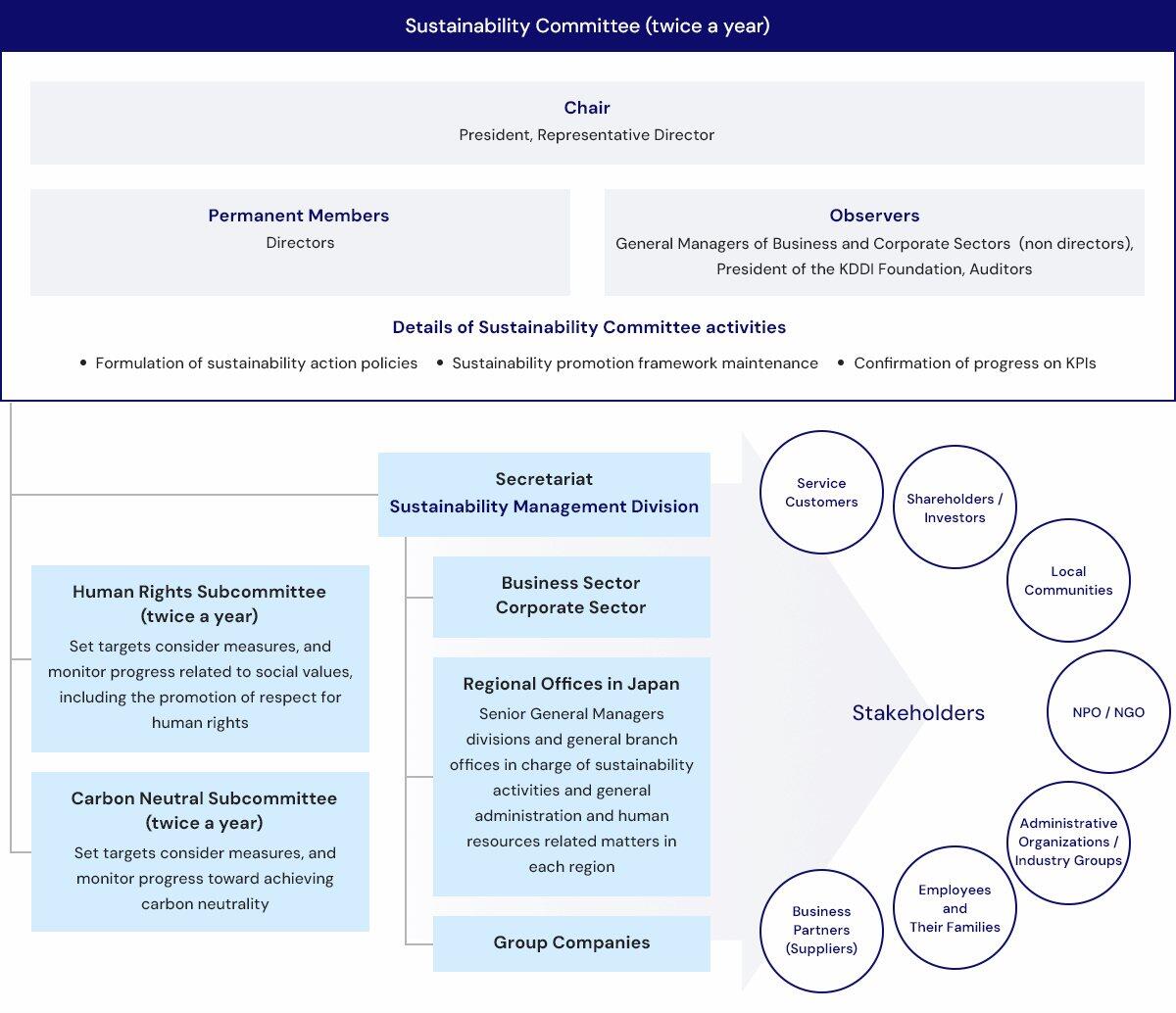
Subcommittees under the Sustainability Committee
Carbon Neutral Subcommittee
Composed of senior executives from technology divisions related to energy, this subcommittee deliberates on targets and initiatives to achieve carbon neutrality.
Human Rights Subcommittee
Comprised of senior executives from internal departments where human rights initiatives are essential―such as Procurement and Human Resources―this subcommittee discusses measures and goals to promote respect for human rights.
The KDDI GREEN PLAN - A medium- and long-term environmental conservation plan

KDDI is currently promoting its environmental conservation plan, the KDDI GREEN PLAN. Positioning harmony with the environment as one of our management philosophies, we have been working on key issues, namely to bring about a decarbonized society, to form a circular economy, and to conserve biodiversity. Furthermore, to raise our corporate value in the medium and long term, we are setting new targets to mitigate and reduce risks and to create business opportunities, aiming to further improve environmental value and invigorate our activities.
This plan and targets were established with the approval of the Sustainability Committee, chaired by the President and Representative Director, and apply to the KDDI Group, suppliers, and partners.
| Reducing risks | Creating business opportunities | |
|---|---|---|
| Decarbonized society |
|
|
| Circular Economy |
|
|
| Biodiversity |
|
|
See below for the details and initiatives of the targets
Decarbonized society, Carbon neutral, net zero
The KDDI Group recognizes that it is an important responsibility as a global company to promote global environmental protection so that we can pass on our irreplaceable earth to the next generation, and we will continue our efforts to ensure a prosperous planet for the future.
The KDDI Group aims to achieve carbon neutrality CO2 emissions for Scope 1 and 2 *1 of the entire KDDI Group by fiscal 2030 and net zero *2 including Scope 3 by fiscal 2040.
The roadmap for achieving new targets


| Scope 1
KDDI Group
Approximately 2% of its CO2 emissions |
Details | In-house power generation at communication facilities, fuel consumption by cable-laying vessels, thermal power generation | |
|---|---|---|---|
| Methods | Offsetting being planned by quality-guaranteed carbon credits (absorbing and removing types (carbon-absorbing and removal origin)) | ||
| Scope 2
KDDI Group
Approximately 98% of its CO2 emissions |
Details | Electricity comprises approximately 99% of the energy used by communication facilities (of which stations, and station buildings and datacenters account for 50% each), and approximately 1% is from heat and steam | |
| Methods | Power |
|
|
| All Telehouse-brand datacenters around the world will aim to switch to net-100% renewable energy by the end of fiscal 2025, by the means above *4. | |||
| Heat and steam | Offsetting being planned by switching to electricity and turning to quality-guaranteeing certificates and carbon credits (absorbing and removing types (carbon-absorbing and removal origin)) | ||
| Scope 3 | Details | Approximately 95% falls into Category 1 (purchase of services and products) and Category 2 (capital goods) | |
| Methods | Request and support initiatives aimed at visualizing and reducing CO2 emissions for business partners (sharing knowledge on CO2 emission reduction through dialogues, providing guidebooks, and similar methods) | ||
- *1We plan to reduce over 97% of Scope 1 + 2 emissions, with the remaining approximately 3% offset by quality-assured carbon credits and other means.
- *2In accordance with the "Net Zero Standard for Corporations" published by the SBTi (Science Based Targets initiative, an international climate change initiative), KDDI aims to achieve a substantial reduction in CO2 emissions from its business activities, including emissions from Scope 1 and Scope 2, as well as Scope 3 emissions across the entire supply chain to net zero. This involves reducing Scope 1 + 2 emissions by over 97% and Scope 3 emissions by over 90% (as an intermediate target for Scope 3, a 28% reduction compared to 2019 levels by the fiscal year 2030).
Any remaining emissions (less than 3% for Scope 1 + 2 and less than 10% for Scope 3) will be offset using quality-assured carbon credits and other methods. - *3Abbreviations
- PPA: Power Purchase Agreement. A system where PPC business operators build solar power generation facilities on idle land and the like owned by parties needing electricity, providing renewable energy
- RE100: Renewable Energy 100%. An international initiative aimed at procuring energy used in business activities completely from renewable energy sources
- FIT: Feed-in-tariff system. A system that mandates electricity companies to purchase the electricity produced by solar power and wind power facilities at the prices specified by the state
- I-REC: International Renewable Energy Certificate. One of the renewable energy certificates overseas
- *4Targets at datacenters
- The Telehouse datacenters covered by these targets refer to the datacenters whose buildings and facilities are owned by the KDDI Group. Excluded are the types where the KDDI Group borrows part of other companies' datacenters as facilities to provide services.
- These targets do not include communication station buildings for company businesses, resale of other companies' services, and datacenters not included in consolidated financial statements. Communication station buildings for company businesses aim to achieve carbon neutrality CO2 emissions by fiscal 2030 (Scopes 1 + 2.)
- Under Scope 2, the plan is to switch to using 100% of electricity from renewable sources by fiscal 2025, and for heat and steam sources to achieve carbon neutrality CO2 emissions by fiscal 2030 together with Scope 1.
- Telehouse customers who procure their own environmental values may be excluded from the coverage.
- Datacenters that are scheduled for closure are not covered by these targets.
Renewable Energy Business
We launched solar power generation business in November 2013 with the aim of contributing to reduction of CO2 emissions. We constructed solar power generation facilities on part of company-owned land in seven facilities of four locations around Japan and sell the power to electric power companies based on the Feed-in Tariff Scheme for Renewable Energy.
Since September 1, 2021, in "au Denki" electricity supply service, KDDI has offered the "eco Plan." The practical renewable energy rate of this electricity supply plan is 100%, contributing to reduce CO2 emission from the society. The rate of renewable energy of our procured electricity has achieved 100% by supplying electricity together with non-fossil fuel energy certificates that have environmental value of not emitting CO2, such as solar and wind power. The plan has introduced a system that 2% of electricity charges will be donated to conservation efforts for the global environment, which allows KDDI to work together with customers to contribute to realize decarbonized society. The subsidiary, ENERES Co., Ltd. offers eco-friendly services, such as "RE100 Menu" that supplies electricity generated only from renewable energy sources that meets the RE100 criteria and "Non-Carbon Menu" that supplies electricity without any adjusted emission coefficients, and thus has contributed to customers' initiatives to mitigate global warming through its business.
Circular Economy
In order to reduce our environmental impact from waste produced through business activities, we effectively utilize our resources to contribute to the formation of a Circular Economy.
Furthermore, toward realizing a circular economy, we develop systems to track electronic waste, including mobile phones, and collect and monitor performance data.
Promotion of Mobile Phone Recycling
Used (post-consumer) mobile phones collected from customers at au Shops are manually disassembled in secured rooms, with circuit boards, displays, cameras, plastics, screws, antennas, motors, speakers and other parts being separated. Gold, silver, copper and palladium are extracted from the circuit boards, while screws and antennas are recycled into steel products, and plastics are recycled, to the extent possible, into plastic products. When a machine is used to disassemble a mobile phone, plastics are burned up in the incineration process and so cannot be recycled.
Recycling eliminates any need for new mining and refining of mineral resources such as oil, iron, gold, silver and copper, while also reducing the amount of carbon dioxide that is generated by materials processing.
Therefore, we at KDDI perform all disassembly manually to prevent recyclable resources from being wasted. On February 19, 2021, KDDI received the Resource Recycling Award of the 18th Corporate Philanthropy Award organized by the Japan Philanthropic Association for its initiatives for such material recycling and the creation of employment opportunities for people with disabilities in manual disassembly of mobile phones.
To further promote the collection of used mobile phones, we have installed and publicized collection boxes at au Style/au Shops, UQ Spots, Toyota dealers handling au services, and venues of "Starting Up Old Phones: A Trip Down Memory Lane" to collect used mobile phones for recycling.
Basic Flow for Recycling of Mobile Phones
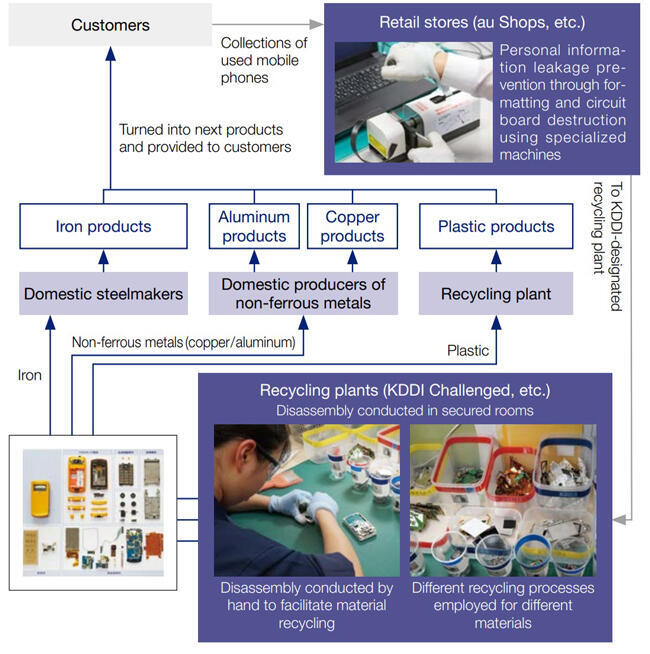
The KDDI Group holds the "Smartphone Disassembly Class," a program to deepen understanding of material recycling and a Circular Economy through disassembly of smartphones, throughout Japan.
In FY2023, the program was held 19 times in 15 prefectures, with 347 elementary and junior high school students participating.
Social Impact of Mobile Phone Recycling
By safely and reliably collecting and recycling used mobile phones, we reduce the waste-management burden on society as a whole, circulate the precious metals and materials recovered during the collection process within society, and achieve the sustainable use of resources. Furthermore, through these initiatives, we accelerate the realization of a circular economy in which everyone can participate. These initiatives are among our efforts that also contribute to achieving carbon neutrality, which is one of our material issues, and we will continue to strengthen these initiatives.
Converting the social impact of our initiatives in fiscal 2024 into monetary terms resulted in 54 million yen*.
* Total proceeds from the sale of mobile phones collected in fiscal 2024
Biodiversity
KDDI, together with its suppliers and partners, will promote initiatives to conserve biodiversity and achieve zero deforestation through our business to realize a society that coexists with nature.
We aim to reduce the impact of our business activities on biodiversity and achieve no net loss and net positive impact at the sites containing globally or nationally important biodiversity.
First, we will avoid land-use changes due to the construction of communications facilities in and around biodiversity area. If the construction is unavoidably accompanied by land-use changes, we will apply a mitigation hierarchy to minimize the impact on biodiversity, restore it, and achieve no net deforestation by FY 2030.
Obtained SBT Net-Zero Certification from the international climate change initiative
In January 2025, the KDDI Group has obtained SBT Net-Zero certification from the international initiative "SBTi (Science Based Targets initiative)." To achieve its net-zero targets, the group will further promote energy efficiency in telecommunications equipment, shift to renewable energy, and implement climate change measures through collaboration with suppliers, thereby contributing to the preservation of the global environment.
KDDI's effort to conserve environment
As the KDDI Group benefits greatly from the natural environment, we believe it is important to promote activities to address environmental issues. In order to pass on our irreplaceable earth to the next generation, KDDI Group employees are engaged in various activities to preserve the global environment in cooperation with various stakeholders, including local residents, governments, universities, NGOs and NPOs.
Engagement with Policymakers and Collaboration with External Organizations to Achieve Carbon Neutrality
KDDI considers achieving carbon neutrality to be one of the material issues in the Mid-Term Management Strategy. As one approach to solving this issue, we engage directly or indirectly in activities at our sites in Japan and overseas in relation to policies, laws, or regulations that could affect the climate.
KDDI's Corporate Communications Division continuously gathers information on outreach from policymakers such as the Ministry of Internal Affairs and Communications and the Ministry of Economy, Trade and Industry. For matters requiring action, such information is disseminated to relevant departments within the company. Important climate change-related issues disseminated are examined in the relevant departments, and the results of those examinations are reported to the Carbon Neutral Subcommittee and the Sustainability Committee. The President, who chairs the Sustainability Committee, bears ultimate responsibility and responds directly to policymakers through KDDI's Corporate Communications Division. In addition, under the responsibility of the chair, the Sustainability Management Division monitors activities in industry groups, including evaluating and managing whether they align with the Paris Agreement (to keep the increase in average temperature well below 2°C above pre-industrial levels and to strive to limit the increase to 1.5°C) and whether they are consistent with our climate change policies and the direction of our initiatives.
By contrast, when KDDI engages with policymakers, outreach by an individual company is not expected to be effective. Therefore, after reporting to the Carbon Neutral Subcommittee and the Sustainability Committee, we engage indirectly with policymakers through Keidanren, which coordinates industry groups. If the measures taken by the groups we belong to are insufficient, we will make joint proposals with other companies to strengthen the measures; if they are still insufficient, we will consider withdrawing from such groups.
Through these various engagements, including direct and indirect approaches to policymakers and financial support for startups, we carry out activities aimed at achieving carbon neutrality for both KDDI and society.