Stakeholder Engagement
Stakeholder Engagement: Our Approach and System
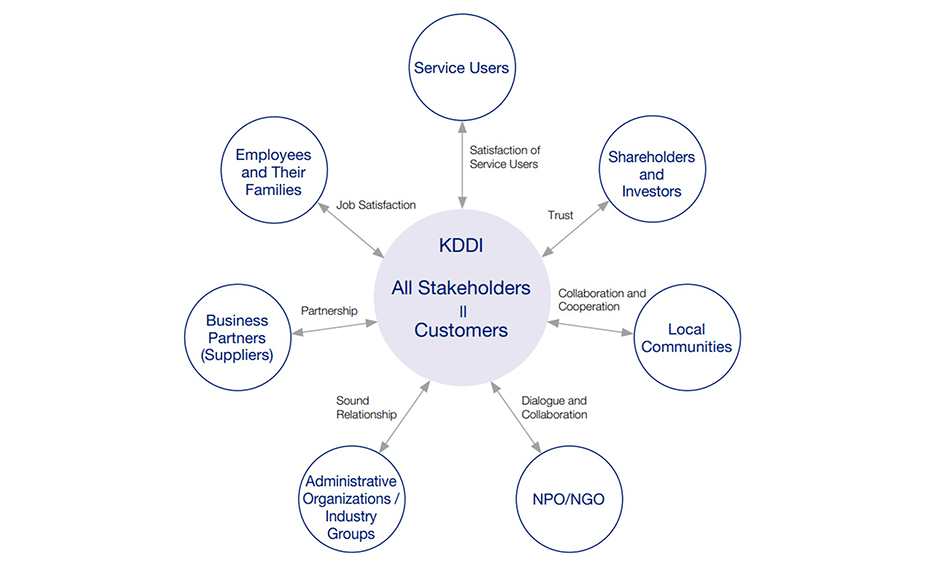
Stakeholders that influence our businesses are diverse, ranging from customers, shareholders, business partners, employees and their families to local communities, etc. We at KDDI implement various activities to offer new, satisfying experiences to all stakeholders in our business operations.
We also use the GRI Sustainability Reporting Standards, SASB, IIRC, ISO 26000 and other global sustainability standards; JIS Z 26000, Environmental Reporting Guidelines, Guidance for Collaborative Value Creation and other domestic standards; and checklists that consist of questions we receive from investors. With these, we create and implement policies for assessing our current conditions and addressing management issues.
The results of engagement efforts are not only reported and shared within the company but also reported at relevant committees and management meetings and reflected in the decision-making process. KDDI values the dialogue with all our stakeholders who support us. We will continue to build up collaboration with our stakeholders and tackle societal issues to contribute to the development of a truly connected society.
Stakeholder Identification and Prioritization Process
From the perspective of achieving sustainable growth for both the company and society by enhancing social and environmental value in addition to economic value through our diverse business with telecommunications at the core, we have identified seven main stakeholders: service customers, shareholders/investors, local communities, NPO/NGO, administrative organizations/industry groups, business partners (suppliers), and employees and their families. Furthermore, in the implementation of stakeholder engagement, we assess factors such as the impact of stakeholders on the KDDI Group business activities before conducting prioritization.
Stakeholder Engagement Feedback and Risk Response
To mitigate potential risks in our engagement efforts, we employ diverse methods, such as dialogue, to ensure that divergent objectives and unrealistic expectations toward KDDI do not arise. Additionally, we are actively committed to effective engagement through regular evaluations of its effectiveness. We are making efforts to ensure stakeholder engagement is not affected by factors such as language differences and others with stakeholders from various countries by enhancing English support and information disclosure on our website. Each engagement result is, of course, reported and shared internally, and depending on its significance, it is also reported in various committees and the Corporate Management Committee and reflected in decision-making. Furthermore, when necessary, pertinent information will be shared with relevant stakeholders through our website, reports, and other channels.
Stakeholder Correlation Diagram
Stakeholder Dialogue
We conduct stakeholder dialogues led by the Executive Officer of Sustainability. Through these dialogues, we incorporate the opinions and requests of stakeholders into our corporate management to build schemes for further improvements.
In fiscal 2023, we invited external experts to discuss and share their evaluations and expectations regarding KDDI's initiatives with a focus on "environments" and "human rights." The feedback received will be used to inform our future measures.
Results of Stakeholder Engagement
Service Users
We strive for the satisfaction of our service users (customer experience) by living up to their trust and offering safe and valuable products and services.
| Content of Engagement | Influence on the management and business activities |
|---|---|
|
|
Shareholders and Investors
We work to build a relationship of trust through honest and fair disclosure of information and active communications.
| Content of Engagement | Influence on the management and business activities |
|---|---|
|
|
Local Communities
We collaborate and work in partnership with local communities and fulfill our duties as a corporate citizen.
| Content of Engagement | Influence on the management and business activities |
|---|---|
|
|
NPO/NGO
We contribute to a better society through dialogue and cooperation.
| Content of Engagement | Influence on the management and business activities |
|---|---|
|
|
Administrative Organizations/Industry Groups
We comply with the law and maintain sound relations.
| Content of Engagement | Influence on the management and business activities |
|---|---|
|
|
Employees and Their Families
We continue to be a dynamic company that provides job satisfaction to all employees.
| Content of Engagement | Influence on the management and business activities |
|---|---|
|
|
Business Partners (Suppliers)
We build partnerships based on mutual trust and carry out appropriate business activities with fair and open transactions.
| Content of Engagement | Influence on the management and business activities |
|---|---|
|
|
Stakeholder Engagement Program (Local Communities)
Approach to Engagement with Local Communities
As a telecommunications company, we strive to understand the concerns of local communities through dialogue and business collaboration in all of our local operations. We promote initiatives that contribute to solving social issues and enhancing safety and development in collaboration with local governments and communities.
Approach to Assessing Impacts on Local Communities
We analyze the impact of our business activities on the culture, communities, and environment of each region, and assess potential risks and opportunities.
Approach to Local Community Engagement
We facilitate regular dialogue with local community members to understand their expectations and concerns, and incorporate these insights into our business planning.
To ensure that stakeholders in local communities are not hindered by language barriers or lack of access to information, we implement capacity-building measures such as delivering messages in easy-to-understand language and introducing engagement policies, programs, and communication channels through group training and workshops.
An example of this is the KDDI Smartphone and Mobile Safety Class, which is held for various groups including students, the elderly, special needs schools, schools for the deaf, and individuals with visual impairments.
For visually impaired participants, we provide experiences such as registering schedules and making voice and video calls using features like “Voice Over” and “Siri,” including simulations where video calls help guide them to safety during disasters. These efforts aim to support independence and ensure safe and secure use of mobile phones.
We also conduct regular surveys through dialogue to assess whether our activities are helping to resolve local community issues. By identifying and prioritizing these issues, and continuously collaborating using our technologies and services, we fulfill our role as a member of the local community.
| Dialogue Opportunity | Identified Issues | Main Responses |
|---|---|---|
| DX Individual Consultation Desk (Sanjo City, Niigata Prefecture) | Business transformation in various municipal operations; demand for digitalization (paperless processes, BPR, etc.) | KDDI employees seconded to Sanjo City regularly conducted interviews with local and municipal staff to identify issues and concerns, and implemented the following responses:
|
| Online Workshop on “How to Use Smartphones Properly” (Nagisa Junior High School, Kobe City) | Online troubles caused by smartphone use at school; reduced study and sleep time due to smartphone dependency among junior high school students | Based on interviews about junior high school students’ smartphone usage and perceptions, KDDI updated its Smartphone and Mobile Safety Class materials and held classes nationwide |
Local community members can contact us directly through the following channel.
Please note that the number of complaints received from local communities in FY2023 was zero.
Participation in External Initiatives
We endeavor to participate and play a leadership role in initiatives and organizations in and outside Japan to contribute to the development of a truly connected society.
| Initiative | Position |
|---|---|
| International standardization of telecommunications | |
| ITU Radiocommunication Sector (ITU-R) |
|
| ITU Telecommunication Standardization Sector (ITU-T) |
|
| Asia-Pacific Telecommunity (APT) |
|
| 3rd Generation Partnership Project (3GPP) |
|
| GSM Association (GSMA) |
|
| OpenID Foundation |
|
| O-RAN ALLIANCE |
|
| IOWN Global Forum |
|
| Building a Safe and Secure Society | |
| Japan Smartphone Security Association (JSSEC) | Vice Chair / Director / Secretary |
| Telecommunications Carriers Association (TCA) | Chair / Director |
| The Foundation for MultiMedia Communications (FMMC) | Director |
| Communications and Information Network Association of Japan (CIAJ) | Director |
| Internet Content Safety Association (ICSA) | Director |
| Promotion of Diversity | |
| NPO J-Win | Advisory Board Member |
Topics
The GSMA is engaged in activities to promote initiatives aimed at achieving the SDGs in the mobile-centric telecommunications industry. The SDGs report published by the GSMA in 2024 states that KDDI has upgraded its four environmental targets, including a group-wide target of achieving net zero by the end of fiscal 2040, to accelerate the realization of a decarbonized society. The report also states that, as part of its initiatives to achieve the targets, KDDI is improving the energy efficiency of its facilities through technology development, switching to renewable energy, and generating renewable energy through au Renewable Energy, which it established, thereby contributing to the decarbonization of society through these activities.
Visualization of Social Impact
KDDI has conducted activities to analyze and visualize the relationship between non-financial activities and corporate value, as an initiative to promote sustainability management. In fiscal 2023, we implemented impact-weighted accounting in our IoT business and worked to visualize the social value generated by our businesses, including the reduction of damage during traffic accidents through emergency alerts.
Furthermore, in fiscal 2025, following this work on our IoT business, we also conducted an analysis of the KDDI Group’s security services using impact-weighted accounting. In addition to the deterrent effect on cyberattacks, we confirmed the existence of both direct and indirect social value, such as career advancement for security talent and improvements in well-being resulting from the creation of leisure time through reduced commuting time.
Through these initiatives, we will continue to clarify the impacts that our various business activities have on society.
Contact Information for Stakeholder Engagement
Stakeholders can contact us directly to report any concerns.
Sustainability Development Department, Sustainability Management Division
engagement-inquiry@kddi.com