KDDI's Commitment to Sustainability
Vision/Policy
Sustainability Promotion Framework
The President of KDDI serves as the chair, with the remaining committee members made up of the executive directors and general managers of all the businesses and corporate sectors, the Audit & Supervisory Board members of KDDI, and the President of the KDDI Foundation. The committee considers sustainability to be a pillar of company-wide business strategies.
Improvements in sustainability are incorporated into company-wide KPIs and are linked to executive remuneration and bonuses for all employees.
The Sustainability Committee makes recommendations to the Board of Directors, which then approves and supervises sustainability activities.
Major Reports Submitted to the Sustainability Committee:
- Performance reports on medium-term sustainability targets
- Progress updates on initiatives to promote sustainability management
- Efforts related to the Supplier ESG Program
- Formulation and approval of sustainability promotion plans for the next fiscal year
Policies and commitments related to sustainability*1 are discussed and formulated by the Sustainability Committee. Depending on their significance, these are reported to and approved by the Board of Directors.
- *1Environmental Charter, Biodiversity Commitment, Zero Deforestation Commitment, Stakeholder Engagement Policy, Human Rights Policy, and Occupational Health and Safety Policy etc.
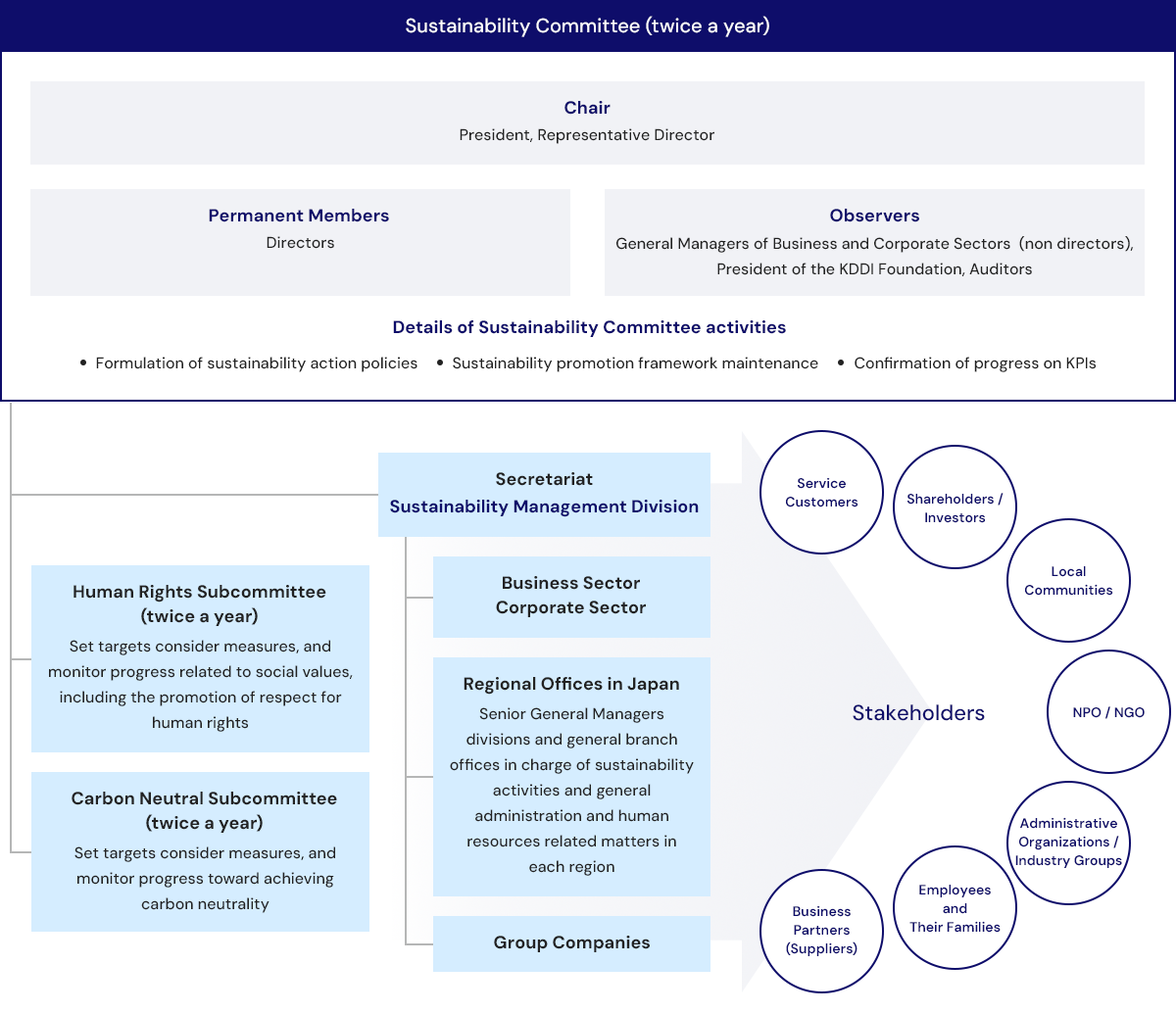
Subcommittees Under the Sustainability Committee
Carbon Neutral Subcommittee
- : A body that comprises executives from energy-related engineering divisions and other members, and considers targets and measures for achieving carbon neutrality.
Human Rights Subcommittee
- : A body that comprises executives from relevant internal divisions where efforts to respect human rights are required (such as procurement and human resources divisions) and other members, and considers measures and targets to promote respect for human rights.
Internal Engagement Initiatives for Implementing Sustainability Management
To ensure broad and continuous understanding of sustainability management across all levels―from senior executives to every employee―we have designed a step-by-step approach as shown in the diagram below. Through repeated initiatives, we continuously promote deeper understanding, aiming to foster new learning and awareness.
■Framework for Internal Dissemination (FY2025)

The KDDI Group Philosophy/KDDI Code of Conduct
The KDDI Group Philosophy, Group-wide Efforts
To ensure that all executives and employees can put the KDDI Group Philosophy and the KDDI Code of Business Conduct, which form the foundation of sustainability management, into practice in their daily work, KDDI annually conducts structured, tiered training and study sessions. Through programs tailored to each level, such as executive directors, leaders, members, and new hires, we promote understanding and practice of the corporate philosophy.
In addition, we ensure continued dissemination by distributing a shortcut to the online KDDI Code of Business Conduct to work devices and implementing compliance-related e-learning, among other measures.
Through these initiatives, we promote corporate activities in which each employee reflects the corporate philosophy in their own actions.
Training for new recruits (for regular employees)
"Compliance: basic practices"
E-learning (for regular employees)
- "Insider Trading Regulations"
- "Preventing Misrepresentation"
- "Unconscious Bias"
- "Power Harassment"
Distribution of web shortcuts related to the KDDI Code of Business
Conduct to business mobile devices
- For executives, regular and contract employees, temporary staff, and subcontracted employees who have been given business mobile devices
Implementation of a survey on the awareness and understanding of the Business Ethics Helpline
- For regular and contract employees, temporary staff, etc.
- Period: January, 2025
- Results: 99.9% awareness of the Business Ethics Helpline
Group companies' training on governance
- For executives of group companies, etc.
- Number of participants: 86
- Evaluation: Satisfied 100%