Flexible Working Arrangements
Initiatives to Improve Productivity
We offer a range of systems that allow employees to flexibly choose work styles that maximize their productivity according to their circumstances.
We also provide programs for employees’ career development and skill enhancement outside of their working hours.
| System / Program | Content |
|---|---|
| Discretionary work system | Employees who are engaged in highly specialized work and have broad autonomy in performing their work may allocate their time efficiently at their own discretion and choose a work style that prioritizes maximizing performance. |
| Flextime system | Employees may decide their daily working start and end times and working hours by themselves within the flexible time band (no core time). |
| Variable working hours system | Employees may change their prescribed working hours in 1- or 3-month increments based on workload. They may also combine this system with shortened working hours for childcare or family care. |
| Work-interval system | To raise awareness of healthier work styles, this system ensures a minimum rest period of 9 hours from the end time of one work shift, including overtime work, to the start time of the next work shift. We conduct interviews with an occupational physician as needed for employees who have exceeded a certain number of instances with less than 11 hours between shifts. |
| Telework |
Employees may work remotely if telework increases their productivity and operational efficiency compared with working at the office.
|
| Lifelong learning leave program | This program allows employees who wish to independently acquire qualifications or skills to take a leave of absence for a certain period (up to 3 years). |
| External side job program | If employees apply to the company and their applications are approved, they may engage in external side jobs. To help employees enhance their skills and develop their careers, KDDI permits certain external side jobs based on an application, in addition to encouraging internal side jobs across the KDDI Group, provided they do not affect the performance of current duties. |
Systems and Initiatives to Support Balancing Work with Childcare and Family Care
KDDI supports employees by implementing systems that exceed statutory standards, so that they can balance work with circumstances such as childbirth, childcare, and family care, aiming for a 100% reinstatement rate from a leave of absence taken for childcare or family care.
In fiscal 2023, we held a workshop for employees and their partners to discuss the sharing of household and childcare responsibilities and father’s leave, and a workshop to dispel anxieties about returning from parental leave of absence and to consider optimal work styles after returning to work. These provided employees with opportunities to explore tips for sharing household and childcare responsibilities and to envision life after returning to work together with their partners. Since fiscal 2024, to enable employees to return to work at their preferred timing, we have introduced services in partnership with company-led childcare centers and have also begun providing consultations on securing childcare arrangements and useful information for childcare.
Although parental leave of absence is unpaid, childcare leave benefits are provided through employment insurance. For employees returning to work, we have also established an environment that enables them to adopt flexible work styles tailored to each individual’s motivation and work circumstances, such as shortened working hours (a short-time working arrangement) that reduce prescribed working hours to 5 to 7 hours, a variable working hours system, and telework. During shortened working hours for childcare and during periods when an overtime exemption or restriction is in effect, transfers that require relocation are not permitted. By utilizing these systems, employees who have taken parental leave of absence return to work at a high rate.
Overview of Systems and Work Arrangements for Balancing Work and Childcare

Leave Systems Related to Pregnancy and Childbirth
| System | Content | Statutory requirements | Provisions exceeding statutory requirements |
|---|---|---|---|
| Maternity leave | Employees may take leave for 6 weeks before childbirth (14 weeks in the case of a multiple pregnancy) and 8 weeks after childbirth, for the purpose of protecting the mother and fetus in the final weeks of pregnancy and aiding the mother's postpartum recovery. | An employer must not have a woman work for 6 weeks before childbirth (14 weeks in the case of a multiple pregnancy; in either case upon the woman’s request), and must not have her work for 8 weeks after childbirth. | - (Available as required by law) |
| Infertility treatment leave |
|
No statutory provision | 10 days of unpaid leave available |
| Paternity leave |
|
No statutory provision |
|
Work Arrangements Related to Pregnancy and Childbirth
| System | Content | Statutory requirements | Provisions exceeding statutory requirements |
|---|---|---|---|
| Less commuting to work and medical visits | To prevent adverse effects on the mother or fetus caused by rush-hour commuting, pregnant employees may avoid commuting congestion by postponing their start time or advancing their end time. | If a female worker who is pregnant or has recently given birth undergoes medical examinations or other tests and receives guidance from a physician or other medical professional, the employer must take the necessary measures, such as changing her working hours or reducing her workload. | - (Available as required by law) |
| Time for antenatal hospital checkups |
|
An employer must ensure that a female worker can secure the time necessary to receive health guidance or medical examinations for pregnant and postpartum women.
|
- (Available as required by law) |
Leave of Absence and Leave Systems Related to Childcare
| System | Content | Statutory requirements | Provisions exceeding statutory requirements |
|---|---|---|---|
| Childcare leave at birth |
|
An employer must, if requested by a worker, allow birth leave for childcare to be taken in up to 2 separate periods, for a maximum of 4 weeks, at any time until the child reaches 8 weeks of age. | - (Available as required by law) |
| Parental leave of absence |
|
An employer must, if requested by a worker, allow leave for childcare to be taken at any time until, at the latest, the child reaches 2 years of age.
|
Available until the child reaches 2 years of age, regardless of nursery school admission status |
| Sick/injured childcare leave |
|
An employer must, if requested by a worker, allow up to 5 days of unpaid leave per year per employee, to be taken in full-day or hourly increments, for a child up to the completion of the third grade of elementary school. |
|
Work Arrangements Related to Childcare
| System | Content | Statutory requirements | Provisions exceeding statutory requirements |
|---|---|---|---|
| Shortened working hours for childcare |
|
An employer must, if requested by a worker who is raising a child under 3 years of age, take measures to shorten the worker’s prescribed working hours (provided that the worker’s prescribed working hours per day exceed 6 hours). | Available until the child completes the sixth grade of elementary school (As stated on the intranet: Until March 31 of the fiscal year that includes the day the child reaches 12 years of age) |
| Childcare time |
|
An employer must, if requested by a woman who is raising a child under 1 year of age, provide time for childcare twice per day, each for at least 30 minutes. | - (Available as required by law) |
| Flextime (advancement or postponement of working hours) |
|
|
Available until the child completes the sixth grade of elementary school |
| Overtime exemption or restriction |
|
A worker with a child who has not yet entered elementary school is restricted to no more than 24 hours of overtime work per month and 150 hours per year, and is exempt from work between 10:00 p.m. and 5:00 a.m. | Available until the child completes the sixth grade of elementary school |
Overview of Systems and Work Arrangements for Balancing Work and Family
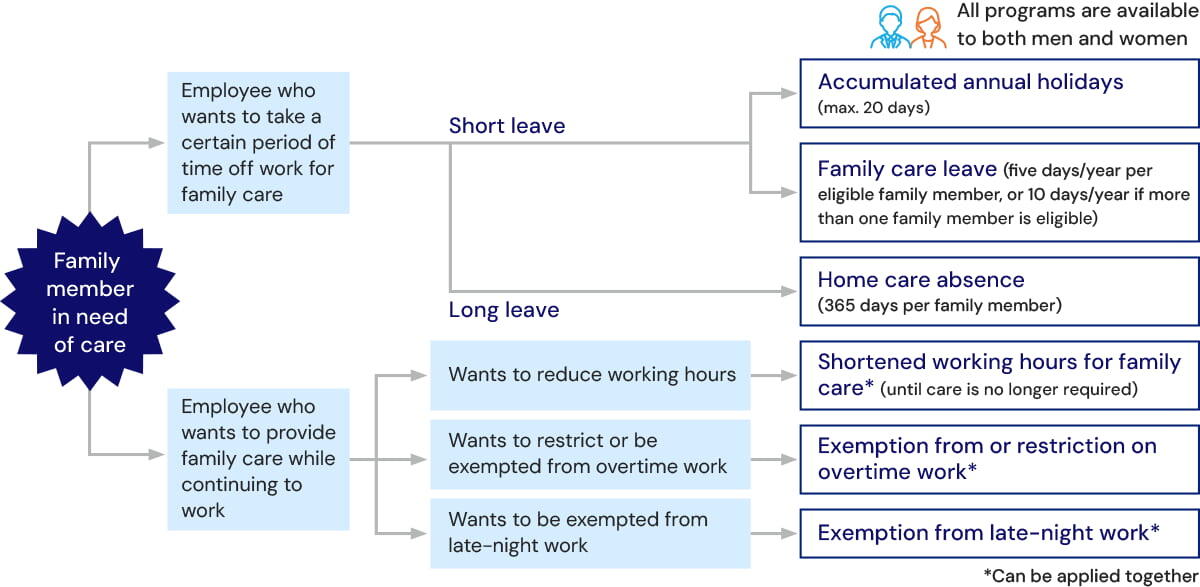
- Family care leave: Paid; use of annual paid leave allowed
- Home care absence: Unpaid; use of annual paid leave allowed
Leave of Absence and Leave Systems Related to Family Care
| System | Content | Statutory requirements | Provisions exceeding statutory requirements |
|---|---|---|---|
| Home care absence |
|
|
Available for up to 365 days per eligible family member (up to 93 days for fixed-term or contract employees) |
| Family care leave |
|
A worker who is caring for an eligible family member in need of care may take up to 5 days of leave per fiscal year (10 days if caring for 2 or more such family members) to provide such care. |
|
Work Arrangements Related to Family Care
| System | Content | Statutory requirements | Provisions exceeding statutory requirements |
|---|---|---|---|
| Shortened working hours for family care | This system supports employees in balancing work and family care by reducing working hours. Employees may choose their working hours between 5 and 7 hours and may change them in monthly increments. They may use this system up to 2 times per eligible family member. Employees may combine this system with the variable working hours system. There is no limit on the number of years of use. This system may also be combined with flextime. | For a worker who is caring for an eligible family member in need of care, the employer must take measures such as shortening the worker’s prescribed working hours for a period of at least 3 consecutive years. Measures to shorten prescribed working hours for family care must be available for use at least twice. | No limit on the number of years of use if family care is needed |
| Overtime exemption or restriction |
|
An employer must, if requested by a worker who is caring for an eligible family member in need of care, restrict overtime work to no more than 24 hours per month and 150 hours per year, and exempt the worker from work between 10:00 p.m. and 5:00 a.m. | - (Available as required by law) |
Initiatives to Support Work-Family Balance
Improvement of the employment environment to support balancing the professional and family lives of individuals, such as workers engaged in childcare or family care
- Flexible work systems that can be chosen according to family and work circumstances
- Implementation of e-learning for all line managers to promote taking parental leave of absence in line with the revisions to the Act on Childcare Leave/Caregiver Leave
- Distribution of emails promoting parental leave of absence to employees whose partners have given birth and to their supervisors
- Introduction of services in partnership with company-led childcare centers
- Trial introduction of subsidies for using housekeeping services
- Subsidies for babysitting fees
- Seminars to raise awareness about balancing work and family care and the posting of a handbook summarizing internal systems on the company intranet
- Support for childcare and family care services tailored to needs through corporate contracts for employee welfare services (such as subsidies for purchasing portable breastfeeding supplies)
KDDI defines harassment as a prohibited act in its work regulations, has established points of contact for consultation, and conducts training to promote a thorough understanding of harassment within the company. Since fiscal 2016, we have also included harassment related to pregnancy and maternity within the scope of our measures and have strengthened these measures.
Support for Male Employees' Participation in Childcare
In addition to expanding the systems described below, we have implemented initiatives to promote understanding and uptake of these systems. Since October 2023, these initiatives have included preparing a paternity, childcare, and parental leave handbook for male employees and posting it on the company intranet.
| System | Content |
|---|---|
| Paternity leave | Employees are granted paid paternity leave within 1 month before or after the expected delivery date or childbirth (in full-day increments for 3 days). |
| Childcare leave at birth | Employees may take leave for a maximum of 4 weeks (28 calendar days) within 8 weeks of the child’s birth. They may also take this leave in 2 separate periods. |
| Parental leave of absence | Employees may take leave until the day the child reaches 2 years of age (the day before the child’s birthday). They may also take this leave in 2 separate periods. |
| Sick/injured childcare leave | This is paid leave for the purpose of nursing a sick or injured child and taking a child to vaccinations or health checkups. Employees are granted this leave up to a maximum of 1 week (5 working days per year) for 1 child, and up to a maximum of 2 weeks (10 working days per year) for 2 or more children. They may take this leave in hourly increments. This leave is available until the child completes the third grade of elementary school. |