AI Governance
- 1. PolicyJump to the applicable section
- 2. AI Governance FrameworkJump to the applicable section
- 3. Risk Assessment EffortsJump to the applicable section
- 4. Employee EducationJump to the applicable section
- 5. Stakeholder CollaborationJump to the applicable section
- 6. Agile GovernanceJump to the applicable section
- 7. Implementation Across Group CompaniesJump to the applicable section
The KDDI Group Mission Statement "The KDDI Group values and cares about the material and emotional well-being of all its employees, and delivers a thrilling customer experience by always going further than expected with the ultimate goal of achieving a truly connected society." Under this corporate philosophy, as a telecommunications carrier that supports social infrastructure, KDDI has been on the social mission to continue providing reliable telecommunications services 24 hours a day, 365 days a year. Among the KDDI Philosophy, we have particularly focused on our credos of "Enhancing the power to connect" and "Responsibility extending 24/7 and 365 days a year" to fulfill our mission and responsibility as a telecommunications carrier that supports society.
As a telecommunications carrier that handles customers' valuable information, KDDI recognizes the protection of personal data, including personal information and the privacy of communications, as its key responsibility. We have advanced governance initiatives in line with the development of technologies and services for ensuring information security and privacy protection.
In an AI-Native Society where AI is deeply integrated into social infrastructure and is "blended" into people's living, KDDI believes that it is responsible for promoting safe and secure AI R&D and Utilization.
Under this belief, KDDI formulated and announced the AI R&D and Utilization Principles for KDDI Group in August 2021. Based on these Principles, we are working on establishing guidelines for the R&D and Utilization of AI services, as well as assessment and governance systems, in order to ensure proper AI R&D and Utilization.
In response to AI-related technological innovations and domestic and international trends, KDDI will ceaselessly review AI governance initiatives while continuing to work on efforts to ensure that customers and society can utilize AI safely and securely, thereby contributing to the improvement of customer experience and the sustainable development of society.
1. Policy
AI governance and risk management
To contribute to the improvement of customer experience and the sustainable development of society while appropriately addressing risks associated with AI R&D and Utilization, upon deliberation and approval of KDDI's management, KDDI formulated and published the AI R&D and Utilization Principles for KDDI Group in August 2021, which sets forth nine principles (Note 1).
To practice these Principles in-house, KDDI also developed AI Development Guidelines as its internal guidelines for AI developers and providers. The AI Development Guidelines provide the following:
- AI Development Guidelines (partial excerpt):
-
- To ensure cybersecurity protection for AI systems and data.
- To introduce a mechanism that enables humans to be involved and intervene in key decision-making.
- To suitably define the scope of AI application and its technical limits in operation in light of holding AI users accountable for any behavior based on results generated by an AI model or agent.
- To prohibit the use of AI for any purposes where its application is not appropriate, including AI uses and practices prohibited by the EU Artificial Intelligence ActOpen in a new window such as purposefully manipulative or deceptive techniques, exploitation of vulnerabilities of people, and social scoring.
Through these initiatives, we practice appropriate AI R&D and Utilization from both aspects of ethics and regulations.
Environmental Conservation
The KDDI Group operates under the KDDI Environmental Charter and recognizes the importance of fulfilling its duty as a responsible global corporate citizen to conserve and protect the Earth's irreplaceable environment that future generations will inherit. We are committed to programs featuring environmental enrichment activities that will benefit all of our descendants.
As part of its global environment protection efforts, KDDI promotes its environmental conservation plan, named the KDDI GREEN PLAN. Positioning harmony with the environment as one of our management philosophies, we have been working on key issues, namely to bring about a decarbonized society, to form a circular economy, and to conserve biodiversity. In the course of our efforts to achieve a decarbonized society, to cope with the increasing power consumption due to the proliferation of AI, the KDDI Group attained its environmental target of sourcing 100% of the electricity used at all of its data centers worldwide from renewable energy in March 2026. Future data centers will also use power 100% from renewable energy sources.
- (Note 1)Nine principles set in the AI R&D and Utilization Principles for KDDI Group:
- [1]Principle of human dignity and individual autonomy
- [2]Principles of proper utilization, user assistance and data quality
- [3]Principles of controllability and human intervention
- [4]Principles of safety and security
- [5]Principles of privacy
- [6]Principles of fairness
- [7]Principles of transparency
- [8]Principles of accountability
- [9]Principles of collaboration
2. AI Governance Framework
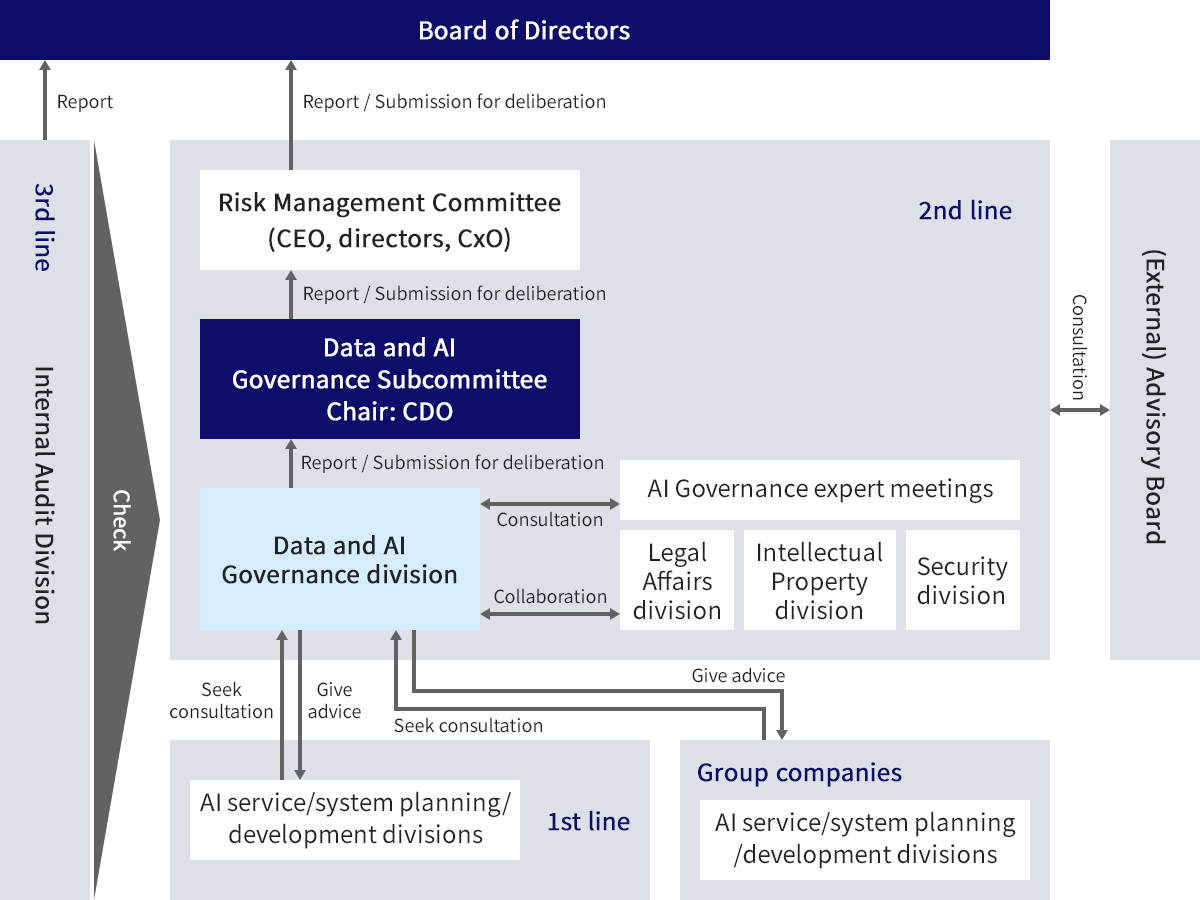
KDDI has established the Risk Management Committee to centrally aggregate and deliberate significant management risks.
The Data and AI Governance Subcommittee, chaired by the CDO (Note 2), is placed under this Committee. The Data and AI Governance Subcommittee decides group-wide governance policies and plans for data and AI, and deliberates actions to be taken for individual risk cases.
KDDI also has in place a risk governance framework based on the concept of the Three Lines Model. Based on the Three Lines Model framework, the Data and AI Governance division is established as a dedicated organization responsible for the second line. This organization is in charge of developing and revising internal rules and conducting risk assessments when developing AI systems and services. The Data and AI Governance division collaborates with other second-line divisions, including Legal Affairs, Security, and Intellectual Property, in its governance activities. Systems are put in place to respond to any incident, where the case is reported to the management as necessary and dealt with.
Additionally, to bring in external insights regarding proper revision of internal regulations and rules as well as AI-related risk assessment, we convene a meeting of the Advisory Board (in Japanese only), which consists of outside experts, approximately twice a year to discuss and exchange opinions about KDDI's efforts.
AI Governance Promotion Framework
- (Note 2)Chief Digital Officer
3. Risk Assessment Efforts
The AI Development Guidelines, one of KDDI's internal guidelines, was established in line with the AI Guidelines for BusinessOpen in a new window, jointly established by the Ministry of Internal Affairs and Communications (MIC) and the Ministry of Economy, Trade and Industry (METI) of Japan. Based on the AI Development Guidelines, KDDI uses the AI Impact Assessment (AIA) (Note 3), which adopts a risk-based approach for assessing risks in AI development.
In the AIA process, the first-line division planning and developing AI services first fills out the designated checksheet with its self-evaluation during the planning phase. In turn, the Data and AI Governance division (second-line) evaluates conformity of the project with the AI Development Guidelines. Then the first-line division takes the necessary risk mitigation measures and proceeds to development. The following criteria are used for evaluation.
- AIA checklist items (examples)
-
- Ensuring human intervention:
Assess the need for intervention of human judgment based on the purpose and intended use of the AI. In particular, for critical decision-making, establish an appropriate operational framework that incorporates human oversight and supervision. - Compliance with internal security regulations:
Strictly limit the handling of sensitive information, such as personal and confidential data, ensuring thorough compliance with internal security regulations. - Disclosure of AI use and ensuring transparency:
Promote clear information presentation and proper understanding for AI users, such as indicating, where necessary that they are interacting with an AI chatbot when AI is utilized.
- Ensuring human intervention:
Even after an AI system goes into operation, KDDI monitors the accuracy and fairness of AI outputs according to risk level and prompts necessary improvements. We also evaluate the fairness and biases of AI models already put into practice depending on their purpose of use.
AIA criteria
| Risk assessment perspectives | Criteria for determining risks | Action |
|---|---|---|
|
|
Perform AIA Recommend reviewing/revising the plan |
|
Perform AIA Hold expert meetings for post-implementation assessment as necessary |
|
| Other than the above | Determine the need for AIA for each project based on the scope of impact |
AIA Process Flow

- (Note 3)KDDI's system of risk assessment for AI development
4. Employee Education
To facilitate employees' proper development and use of AI, KDDI offers an e-learning program on AI governance. This e-learning program covers AI governance, the ethical concept of using AI, and security. All KDDI employees are required to participate in this program.
As another internal educational program for cultivating DX personnel, the KDDI DX University provides not only specialized courses for employees who develop AI services and systems, but also holds hackathons and other internal community activities several times a year as opportunities for such employees to pragmatically learn the risks in and methods for AI development and application.
Overview of KDDI DX University
 |
Program Features | |
|---|---|---|
|
Specialized skills Training programs to learn the skills in each of the 30 specialized fields that support KDDI's business |
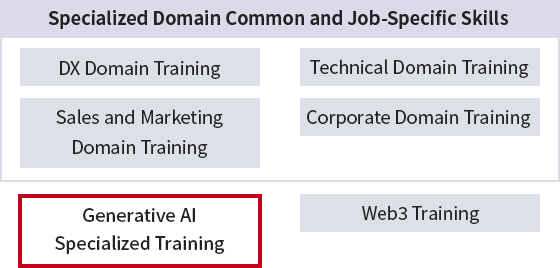 |
Practical programs developed by experts and external partners in each specialized field, designed for easy application in actual work |
|
Portable skills Training programs to learn the foundational skills and knowledge for carrying out work |
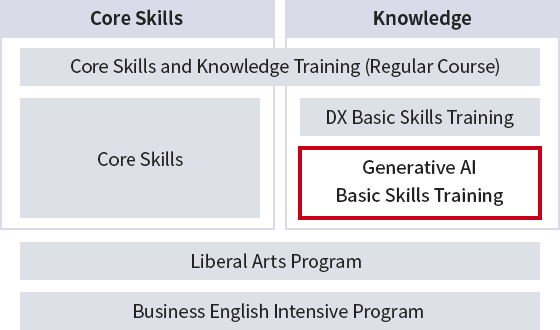 |
Diverse programs that build a robust foundation amid wide-ranging business fields and career opportunities, enabling employees to demonstrate their capabilities even when changing specialized fields or departments |
Training given on specialized skills and portable skills (as of August 31, 2026)
5. Stakeholder Collaboration
KDDI actively participates in governance frameworks in and outside of Japan, thereby contributing to the sound proliferation of AI.
-
Participation in the Hiroshima AI Process Reporting Framework and Publication of Compliance Status
- KDDI participates in the Hiroshima AI ProcessOpen in a new window Reporting Framework launched by G7 and publishes its compliance with the HAIP International Code of Conduct (Note 4). KDDI is also a member of the Partners Community―established in February 2025 to support the Friends GroupOpen in a new window,― a voluntary framework of countries supporting the concept of the Hiroshima AI Process and joins discussions on international rule-making.
-
Participation in AI Governance Association
- KDDI's CDO serves as a director in the AI Governance AssociationOpen in a new window. KDDI participates in the Association's activities aimed at fostering a society where AI governance is the norm.
-
Release of the AI Security Portal
- Toward a society where AI can be used and applied safely and securely, KDDI has released the AI Security PortalOpen in a new window to centralize and communicate information related to AI security in order to widely share its knowledge and findings to the community.
- (Note 4)Publication by Hiroshima AI Process Reporting Framework (OECD)Open in a new window
6. Agile Governance
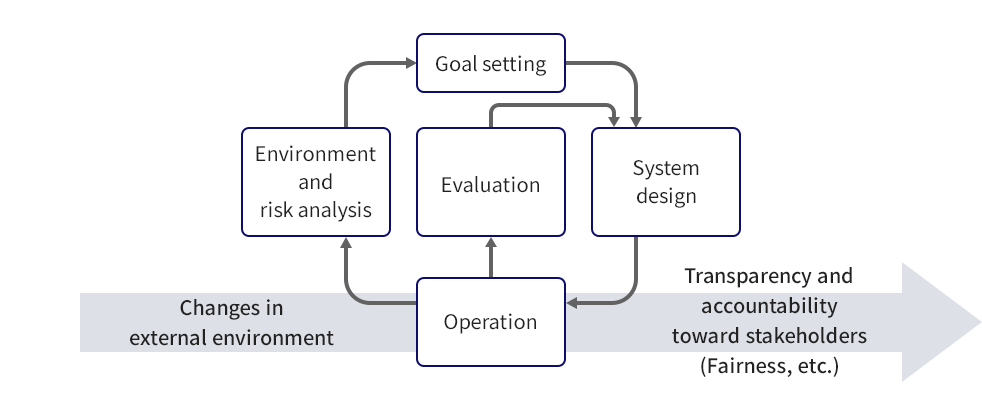
Technical trends and regulations around AI, as well as its social acceptance, are constantly changing, so existing rules and systems may not always continue to be adequate. In response to this, KDDI adopted the concept of "agile governance," presented in the AI Guidelines for Business, and repeats the cycle of the five processes: environment and risk analysis, goal setting, system design, operation, and evaluation.
- (Created by KDDI based on the AI Guidelines for Business)
-
| Agile governance | Specific initiatives |
|---|---|
| Environment and risk analysis |
|
| Goal setting |
|
| System design |
|
| Operation |
|
| Evaluation |
|
7. Implementation Across Group Companies
The KDDI Group is promoting appropriate AI development and utilization group-wide, based on the AI R&D and Utilization Principles for KDDI Group. In addition, KDDI's Data and AI Governance division has established consultation desks for Group companies and supports them in building AI governance systems and adopting common rules. Specifically, KDDI supports the implementation of governance suited to each company's circumstances by sharing methods such as the AI Guidelines and AIA.