Messages from Outside Directors
September 2026
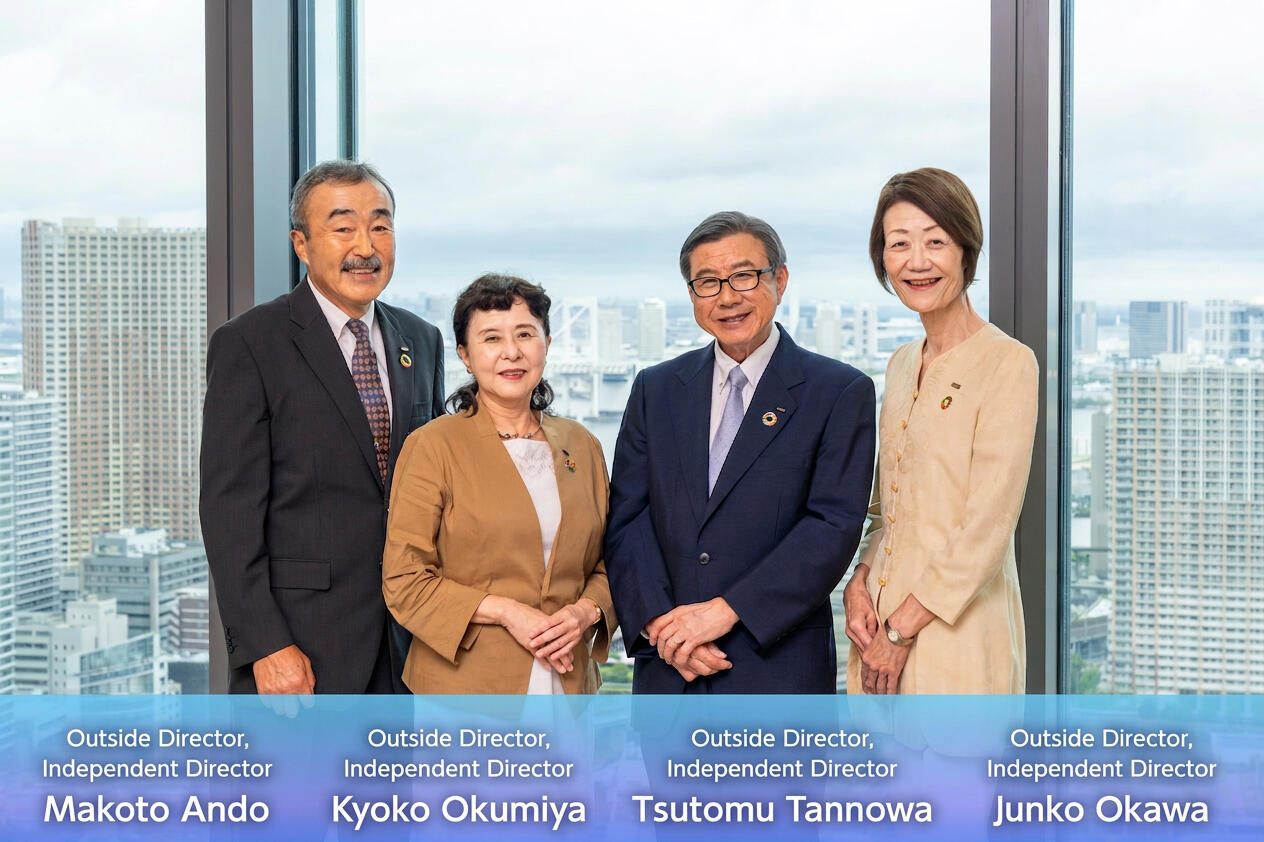
KDDI has formulated a new Mid-Term Management Strategy centered on sustainable growth and quality improvement. At the same time, following an incident of inappropriate transactions at Group company, KDDI also recognizes the further strengthening of Group governance as a critical management issue. In this interview, we asked our outside directors about discussions held at the Board of Directors regarding the formulation of the Mid-Term Management Strategy, as well as their awareness of the challenges involved in strengthening governance.
A new Mid-Term Management Strategy was announced in May 2026. What points did you focus on in the discussions on formulating the strategy, and how do you view the direction of KDDI's growth?
- Tsutomu Tannowa
- The Mid-Term Management Strategy is a three-year plan, but at the same time, it also shows how we intend to concretize KDDI's long-term vision. In this strategy, I believe we were able to clearly demonstrate the fusion of AI's social implementation with KDDI's strengths―its communications infrastructure, customer base, and technological capabilities. The concept of "Fusion" truly represents what KDDI is all about. The direction of creating new value by connecting diverse assets―communications infrastructure, Starlink, data centers, and customer touchpoints including LAWSON―is very clear. Going forward, it will be important to communicate this value effectively to investors and other stakeholders.
- Makoto Ando
- The concept of "Fusion" and the fusion of AI with KDDI's communications infrastructure that Mr. Tannowa mentioned resonate strongly with me as well. Having served as an outside director for two years now, what I feel anew is the breadth of the themes KDDI faces. My own specialty is in technology, but at the Board of Directors, we discuss a wide range of topics beyond technology alone, including governance, compliance, the KDDI Group Philosophy, and sustainability. In this Mid-Term Management Strategy, AI is a major theme. AI is evolving at a pace that exceeds the traditional three-year timeframe of the Mid-Term Management Strategy, and how we approach organizational structure, security, data centers, and even power demand are important discussion points. What particularly stood out to me was the strong focus on "regions" in the strategy discussions. In advancing the social implementation of AI, it is essential to have a perspective that combines communications and electricity to solve regional issues. This is a meaningful direction for KDDI as an infrastructure company in an AI-Native Society. In the telecommunications business, it is also important to distinguish between areas where we should compete and areas where we should collaborate. As an outside director, I try to bring perspectives such as "might there also be this kind of view in the wider world," while participating in discussions with particular attention to balancing the strengthening of KDDI's technological capabilities, delivering value to customers, and meeting investor expectations.
- Kyoko Okumiya
- My area of expertise is legal affairs and compliance, but in the discussions on the Mid-Term Management Strategy, rather than focusing on legal issues themselves, I placed importance on the perspective of how KDDI will grow its business on the premise of governance and compliance. One point we discussed in particular was how to develop its growth areas while further strengthening KDDI's core telecommunications business. To deepen our understanding of the continuously evolving fields of AI and data centers and to exercise appropriate risk oversight, we also took a proactive approach to gathering information, such as having the executive in charge hold study sessions for us. On that basis, we discussed where KDDI currently stands, how far it can advance three years from now, and what investments and partner strategies would be needed to get there. There are many areas that cannot be realized by a single company alone, and we also had active discussions on the effectiveness of KDDI's partner strategy and investment policy.
- Junko Okawa
- Based on my many years of experience working directly with customers, I believe it is important to consider the social value and customer value that KDDI's businesses will ultimately deliver. What I placed particular importance on in our discussions was the "customer perspective" for the coming era, in which customers and companies build an interactive relationship and create value starting from the customer. The concept presented this time of "customer-driven AI-Enhanced Workforce and AI-Enhanced Lifestyle" places importance on how to fuse technological advancement into social life, and I have great expectations for this as an approach through which everyone can experience real value.
- Junichiro Ikeda
- Listening to everyone's comments, what strikes me is the importance of how we think about investment in order to realize these goals. Since I joined as an outside director this fiscal year, I was not involved in the discussions on the from an outside perspective, what left an impression on me was the concept of "actively considering disciplined growth investment." Growth investment is naturally necessary for any company, but adding the word "disciplined" makes accountability for investment decisions clearer. At the same time, we must not focus so much on discipline that we miss opportunities. In the shipping industry, where I previously worked, there were also situations where we had to continue growth investment even under harsh conditions. KDDI has a strong financial foundation and high cash-generating capacity. That is precisely why I believe it is important not to simply adopt a defensive stance, but to actively pursue investment for future growth while clearly articulating why each investment is necessary.
A capital efficiency perspective has been incorporated into the executive remuneration system. What discussions took place within the Remuneration Advisory Committee regarding this change, and how do you view its significance?
- Junko Okawa
- The remuneration system is an important mechanism that supports the improvement of corporate value over the medium to long term. In this Mid-Term Management Strategy, we reflected a capital efficiency perspective in the remuneration indicators, and this sends a clear message about what management prioritizes. It is also important for employees to understand what perspective the company will take in managing the business going forward. In our discussions at the Remuneration Advisory Committee, we also examined the validity of the indicators and the levels of remuneration. Remuneration is a sensitive topic, but precisely for that reason, I believe frank and sincere discussion is essential.
- Tsutomu Tannowa
- I believe incorporating a capital efficiency perspective into the evaluation indicators for executive remuneration was a revision that Until now, business performance and share price have been our evaluation indicators. By clearly requiring management that is conscious of investment efficiency, our decision-making approach becomes easier to understand, and we are better able to fulfill our accountability. I also expect this to encourage investment that aligns not only with short-term results but also with KDDI's long-term growth strategy. KDDI has continued to make forward-looking investments to date, but I believe this revision will lead to management that is even more strongly conscious of balancing capital efficiency with growth.
Through the discussions on the New Materiality and the formulation of the Mid-Term Management Strategy, please tell us about what you have come to feel anew about KDDI's unique character and the strengths of its business.
- Junko Okawa
- I felt a strong commitment behind the six new material issues to clearly articulate KDDI's unique strengths and the social value it aims to create through them. The virtuous cycle with business growth is also easy to understand, and I think the content is realistic. On the other hand, I initially had questions about the removal of "Advancing Stakeholder Engagement." However, after repeated questioning and further reflection, I came to understand that its importance had not decreased, but rather that it had been repositioned as the fundamental premise underlying all of the material issues. In that sense, I feel this represents an evolution of KDDI's previous thinking, rather than a departure from it.
- Junichiro Ikeda
- The first thing I felt as a strength of KDDI was its abundant cash flow and strong financial foundation. This is truly something hard to come by. I also sense a strong sense of responsibility and integrity among KDDI's employees as a social infrastructure company. They share the conviction that communications must never be allowed to stop. This, I believe, underlies the KDDI Group Philosophy, which connects to the thinking established by Kazuo Inamori. It is not an abstract set of principles. It is a tangible, experience-based way of thinking that has permeated the organization, and other companies cannot easily replicate it. Telecommunications will continue to be a foundation of society going forward. Expanding into new business areas on top of this solid foundation is a major strength of KDDI, and a source of its strong future potential.
- Kyoko Okumiya
- I also believe telecommunications is a major strength of KDDI, serving as its unwavering foundation. In this Mid-Term Management Strategy, which emphasizes AI-driven growth, some outside directors, myself included, argued that the value of the communications infrastructure supporting that growth should be clearly demonstrated. In addition, KDDI has a culture of taking on challenges. Carbon neutrality and the declining, aging population are major issues facing society today, and I believe KDDI has the foundation to provide tools that can help solve them. Combining reliability with a spirit of challenge is what makes KDDI unique, and it is a strength I hope will continue to be valued.
- Makoto Ando
- From a technological perspective as well, the strength of this communications infrastructure is a major competitive advantage. KDDI has been a company that values openness, actively pursuing standardization and the use of external technologies, and as a result, it has earned high marks for communications quality and reliability. Looking ahead, low latency, large capacity, and coverage will be critical to AI-Native Society. KDDI has a comprehensive network that combines fixed-line, mobile, and satellite communications, and this is a major strength. At the same time, technological advantage does not last forever. It is essential to maintain that advantage not just through "what we do," but through "how we do it," by continuing to invest in R&D, talent development, and capital investment. This has become an important theme within the Board of Directors as well.
- Junko Okawa
- Listening to everyone's comments, what strikes me is that KDDI has many strengths for growth, including its business foundation, human resources, and favorable industry tailwinds. Precisely because of this, it is important not to become complacent, but to keep confronting competition, regulation, and environmental change. What is required here is balancing a spirit of challenge with risk management. Maintaining President Matsuda's vision of being "A Company That Inspires Passionate Challenges," while also responding to environmental change―this balance, I believe, leads to sustainable growth.
Following the incident of inappropriate transactions at Group company, what challenges do you recognize regarding Group governance and the Board of Directors' oversight function? Also, what kind of strengthening do you believe will be necessary going forward?
- Kyoko Okumiya
- The improper transactions in question occurred at a Group company, but the fact that the problem went unrecognized for such a long period, and could not be prevented, is something all of us outside directors take very seriously. Risk should not be addressed only after a problem occurs; it is essential to analyze and prepare for it in advance, which is why we have also proceeded with establishing the Risk Management Committee. At the same time, this incident has made us keenly aware that challenges remain in Group governance. I believe that, alongside building mechanisms to identify and prevent risk before it materializes, a sense of unity and open communication across the entire Group is also important. At the general meeting of shareholders, we received harsh feedback, with one shareholder asking, "If you talk about the 'Power to Connect,' shouldn't you first connect within the Group?" We take such voices seriously, and it is important to pursue both a culture of mutual support and effective governance. "if only we had pushed just one step further, we would have and the extent of its impact, I am keenly aware once again of the weight of our responsibility. To advance the balance Ms. Okumiya mentioned, I believe we need both philosophy and systems as two wheels of the same cart. In other words, no matter how deeply the philosophy has permeated the organization, people are the ones who make mistakes, and without a system to prevent misconduct, philosophy alone is not enough. As KDDI's businesses diversify, it is essential to enhance monitoring and risk management using AI and data analysis. Conversely, building a perfect system for every expanding business is extremely difficult, and the gaps must be filled by the philosophy of the people involved. Philosophy and systems are two wheels of the same cart, and without both, we cannot achieve true prevention of recurrence.
- Junichiro Ikeda
- The attitude of top management is also important in tightening up Group management. On the surface, this incident points to a shortfall in internal controls, but at the same time, I also felt it reflects the inherent difficulty of managing Group with such a diverse range of businesses and companies. It is not realistic for top management to grasp every detail. Precisely for that reason, though, it is important for leadership to stay engaged with each business and continue signaling, "We are closely monitoring." Incidents like this are also not simply the problem of a single individual; they are shaped by the organization's goals, culture, and the messages conveyed day to day. Strengthening internal control mechanisms is essential, but so is reflecting on what messages the organization has actually been sending. I believe that when management teams across Group companies share a common sense of ethics and ownership, this will lead to preventing recurrence.
- Junko Okawa
- This incident made clear that governance and oversight functions need to evolve in line with the scale of KDDI's business and the breadth of Group management. Early detection of warning signs was needed before the problem occurred. This is a major point of reflection. What matters is not simply declaring that governance will be strengthened. The issues must be correctly analyzed, and the right measures must be taken. It is also not enough to simply implement measures; we must verify whether they are producing the intended effect. Incidents like this leave no room for excuses if KDDI Group Philosophy has not truly permeated the organization. But as Mr. Inamori's words remind us, "There is no finish line." There is no end point to instilling values and ethics. This incident should prompt us to reexamine a range of issues, share them across the Group, and use them to improve the effectiveness of monitoring and management reviews.
- Tsutomu Tannowa
- Regarding this incident, I deeply regret, as an outside director, that we failed to detect the problem for so many years, which ultimately led to such a serious situation. It has made me reconsider what kind of information we should have sought out in order to catch the warning signs. There has also been a view that the corporate culture itself may have been at fault, but I myself, as an outside director, never sensed that kind of pressure. On the contrary, I recognize the culture that encourages employees to take on challenges on their own initiative as one of KDDI's strengths. In response to this incident, we must not swing too far toward risk aversion and end up stifling the very culture of challenge that KDDI has long valued. Going forward, I believe it is important to prevent recurrence through risk identification tailored to the nature of each business and by improving the effectiveness of Group governance.
As sources of competitive advantage in AI-Native Society, the importance of intangible assets such as human resources, organization, and intellectual property is growing. What do you see as KDDI's strengths, and what areas do you think need to be strengthened going forward?
- Makoto Ando
- I have long been involved in human resource development in the field of education, and I feel that securing and developing talent in rapidly emerging fields, particularly AI, is a truly difficult challenge. KDDI is working to strengthen its capabilities in the AI domain, but this kind of talent remains in short supply everywhere, not just in telecommunications, but across every field and around the world. In addition, security and risk management, in which AI is increasingly taking a leading role, cannot be completed by KDDI alone. It requires sharing information and working together across the industry and the world as a whole. I believe that developing talent while also building open collaboration will become increasingly important going forward.
- Kyoko Okumiya
- I believe human resources are a key theme that will determine KDDI's competitive advantage. To achieve further growth going forward, it will be important to provide learning opportunities that build expertise and to create an environment that encourages new challenges. In addition, as Mr. Ando mentioned, exchange and knowledge-sharing that go beyond the boundaries of a single company are also essential to enhancing the value of KDDI's people and organization. I hope to see KDDI make use of collaborative spaces such as its Takanawa headquarters to share business and research achievements and strengthen cross-organizational connections. Furthermore, as its business expands globally, developing international talent who can thrive while engaging with diverse people around the world is another important theme. People are what sustain human mechanisms to support their growth will lead to greater corporate value in the future.
- Tsutomu Tannowa
- In terms of talent development, I feel KDDI already has significant strengths. I believe the strength of KDDI's people and organization lies in the fact that KDDI Group Philosophy is not treated as a mere set of principles, but is something each individual takes personally and translates into action. As symbolized by Mr. Inamori's words, "Asking ourselves if our motives are righteous or selfish?," I feel it is a major strength that a sense of what it means to act rightly as a human being lies at the very core of the organization. KDDI's personnel system is also well-balanced, and I believe this is reflected in results such as its low turnover rate. Going forward, while maintaining these strengths, it will be important to further expand opportunities to build to proactively communicate our talent-related initiatives and achievements to the outside world.
- Junko Okawa
- This connects to everything we've discussed so far, but I believe it is intangible assets, such as human resources and intellectual property, that sustain a company's long-term growth. Intellectual property loses its effectiveness over time, but what matters is the organization and the process of knowledge creation that continue to generate it. Continuously creating new value by connecting insights from both inside and outside the company will lead to greater value in intangible assets.
Finally, we'd like to ask Mr. Ikeda, who joined as an outside director this fiscal year. Based on the discussions so far, what kind of role would you like to play in enhancing KDDI's corporate value?
- Junichiro Ikeda
- What I want to contribute to is helping KDDI enhance its corporate value while meeting the expectations of investors and its many other stakeholders. I believe corporate value does not belong to investors alone; it is built through relationships with a wide range of stakeholders, including society, customers, business partners, and employees. As an outside director, I want to play a role in assessing risk and return, and in giving a push forward when a challenge is worth taking on. In judging future growth investments, I will keep in mind the questions "Why should KDDI do this?" and "What can only KDDI do?" and I will work together with my fellow outside directors to contribute to discussions that lead to enhanced corporate value.
Other IR Information